Friday, January 24, 2003
Magic Roundabout
Round And About "...the most important work in reshaping the series was undertaken by the actor selected to provide the narration, Eric Thompson...He loathed the original French stories, which it is claimed he regarded as simplistic and dull, and refused to work with a straightforward translation. Instead, he watched the episodes with the soundtrack turned down, created new names and personalities for the characters, and invented completely new storylines to match the on-screen action. The resultant scripts were sharp and witty, and traded in language and humour that was far in advance of the level of sophistication that might usually have been expected in a programme of this nature." I just learnt that there's going to be a CGI version of it.

DSpace
An Open Source Dynamic Digital Repository "It is an attempt to address a problem that MIT faculty have been expressing to the Libraries for the past few years. As faculty and other researchers develop research materials and scholarly publications in increasingly complex digital formats, there is a need to collect, preserve, index and distribute them: a time-consuming and expensive chore for individual faculty and their departments, labs, and centers to manage themselves. The DSpace system provides a way to manage these research materials and publications in a professionally maintained repository to give them greater visibility and accessibility over time...Only three fields are required: title, language, and submission date, all other fields are optional...DSpace is the first open source digital repository system to tackle the complex problem of how to accommodate the differing submission workflows needed for a multidisciplinary system...All original code is in the Java programming language. Other pieces of the technology stack include a relational database management system (PostgreSQL), a Web server and Java servlet engine (Apache and Tomcat, both from the Apache Foundation), Jena (an RDF toolkit from HP Labs), OAICat from OCLC, and several other useful libraries."
Tuesday, January 21, 2003
Snapping with SnipSnap
Moblogging go! "SnipSnap DV now supports image attachments (or inlines) in mails. Need to test it with a mobile with a camera."
Right
Tech Predictions for the Decade "Take, for example, the concept of the "semantic" Web, a next-generation version of the Internet that will enable users to obtain more precise information by utilizing computerized "agents" that find exactly what they want online. Today, if users search for "books about Agatha Christie" on Google, they receive hundreds of search results leading to information on the books written by Christie. In contrast, semantic Web agents will be intelligent enough to decipher the word "about" and find biographies on the writer rather than her works, Gantz said."
I'm not even going to start with what's wrong with the statements above. Take a deep breath and start again.
Meanwhile, the Butler Group says about OLAP that: "It is no longer seen as a specialist solution, for business analysts and experienced line of business managers, but as an end user solution, supporting the information needs of a broad range of individuals. Furthermore, OLAP needs to be viewed not as a standalone tool, but as part of a larger integrated BI solution." It's all about the ease of user rather than pure performance.
Joseki 1.0 Released
Joseki is an API to enable Jena models to be accessed over the web using POST and GET. I like this way of doing things. Although, it might not be so good for large queries. You could add a page and page size values (requiring the server to keep state). They've taken the odd step of using JDK 1.4 for logging but not for regular expressions. Even the ORO group are considering using parts of JDK 1.4 (CharSequence) to get better performance.
http://www.joseki.org/
Andy replies "Jena itself runs with Java 1.3 (and Java 1.2, I think - we don't test that during the release cycle) so we include the ORO regular expression package (actually used in the query filters for RDQL).
It's the Joseki server that uses Java 1.4 logging. Too many logging points were arising; there is web server logging, Joseki logging, logging by any query language plugins, ..., so I decided to use Java 1.4.
I also realise that not everyone wants to or is able to move to Java 1.4 just yet. If this comes a problem for anyone I'll fix it." Where's that email and web integrator when you need it.
Sunday, January 19, 2003
What's an Invoice?
OASIS to preview XML system for standard business documents ""An analyst, however, said he doubted OASIS would succeed in providing standard forms for business. "How can hospitals and manufacturing firms and aerospace industries all share the same notion of an invoice?" asked Ronald Schmelzer, analyst at ZapThink in Waltham, Mass.
"Even if they all adopt the core business language, they're going to have different extensions on it," Schmelzer said. "I don't think this is going to be any magic pill," for getting documents to agree with each other, he added.
Schmelzer said he favored a concept known as the semantic Web, which would have computers are more intelligent in understanding semantics.""
Saturday, January 18, 2003
Trackback to the Future
TrackBack in motion. Update on Trackback and related ideas.
Trackback Technologies contains some new Perl and PHP code for the Recent Trackbacks and Backtrack.
Trackback Technologies contains some new Perl and PHP code for the Recent Trackbacks and Backtrack.
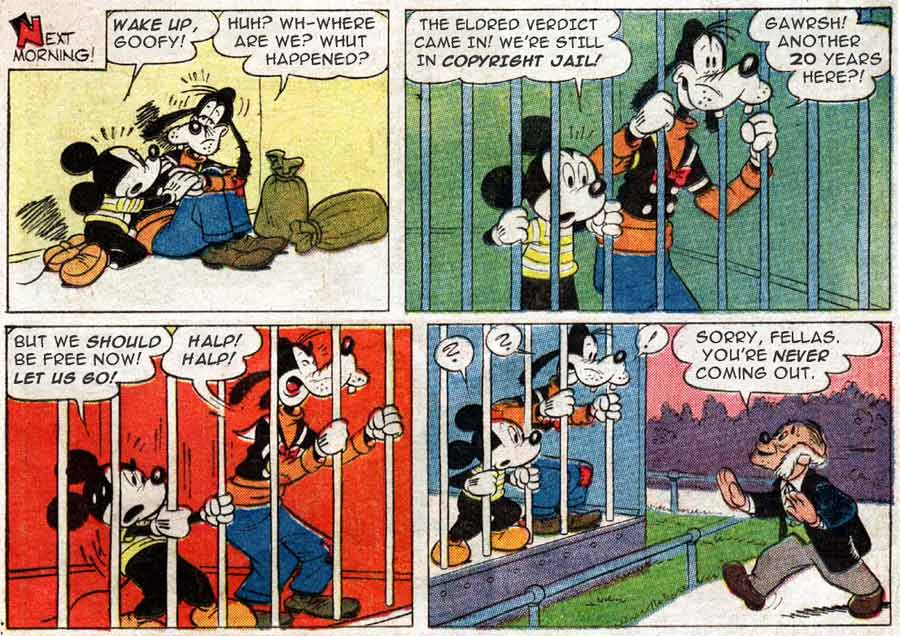
I'd like an Extended Copyright with that
I WANT TO BELIEVE Countries can agree to reciprocal protection. This effectively means that a published work does have the rights based in country it was published. In some ways this is a much more sensible agreement. The sovereignty of a country is preserved. Of course, this could mean boatloads of American copyright refugees.
Anything More?
once more into the breach, my friends? "The easy answer is no. The Supreme Court has ruled that Congress has the power perpetually to extend the terms of existing copyrights. This brief “experiment with the public domain,” as the NYT eloquently put it, is over. In twenty years, we can expect terms will be extended again. There is no good reason to expect anything different.
The hard answer is, well, yes..."
I wonder if international agreements like TRIPS (Article 13) could be used against the US. Of course, something that treats a computer program, with or without source, the same as literary works should probably be ignored.
Also, an amusing interview with Mickey on the decision and comic strip.
Correcting Categorization
Cleaning iTunes "...it works poorly for show tunes -- people seem to really care about the performers, so they get really specific with the artist portion of the ID, to the extent that every song on the CD has a different artist string even though it is the same cast...Some of the things I want to clean up are bad data, and some are matters of Gracenote policy I disagree with, like inserting "(Disk N)" at the end of album names for multi-CD sets. In my iTunes Music Library, I get to have things my way...If I change the tag in iTunes, it updates the iTunes database and playlists, updates the ID tag in the actual MP3 file, and moves the file to a new artist directory if my music is in the iTunes Music Library. This is all very cool." The author writes some AppleScript to modify the ID tags to his taste.
The Misuse of Metadata
Creative Comments: On the Uses and Abuses of Markup This pretty much says the same things I've been saying of late such as, "The Semantic Web isn't a replacement, it's a supplement.". I'm not going to bother bringing a whole lot of context here as the article is actually about the Creative Commons' (and apparently Trackback's) misuse of the comment tag and embedding RDF into HTML.
"Surely, I wondered, they know that putting RDF into HTML comments is an inelegant way of relating human and machine-consumable resources? Creative Commons, which has taken on the laudable task of creating RDF descriptions of common licensing terms for intellectual property, suggests its users associate machine-consumable licensing terms...with the web resources to which they apply by embedding RDF directly in HTML comments...In short, markup language comments are for communicating with humans, not with machines. The problem with incoherent strategies is that it's not always possible to predict all the ways in which they will fail or go bad."
It's a shame that a really good use of RDF has decided to do it in such a non-standard, if simple way. RSS is a really good example of how this separation is good. New proposed standards like SMBMeta (or Whoogle) propose the same thing. The author suggests the link tag to link to the licence. I guess you could also use the meta tag to embed the extra metadata.
Using this example:
<meta name="dc.title" content="Anti-war demonstrators">
<link rel="schema.dc" href="http://purl.org/metadata/dublin_core_elements#title">
<meta name="dc.date" content="2002-09-28T14:36:54">
<link rel="schema.dc" href="http://purl.org/metadata/dublin_core_elements#date">
This is using the Dublin Core Guide.
Thursday, January 16, 2003
Wednesday, January 15, 2003
Nokia Tools for Linux
Nokia woos Linux programmers "Nokia, the top seller of mobile phones, has released software to let Linux programmers develop Java software for its mobile phones."
For JBuilder and NetBeans for Nokia Series 40.
The download is available here.
For JBuilder and NetBeans for Nokia Series 40.
The download is available here.
Scopeware
Why Automatic Information Management is Doomed to Fail "I firmly believe the answer lies within each individual user. The user should always be in control of their information. You should be able to organize your information in a way that makes sense to you, rather than have to figure out how the computer has organized your information.
I propose an information management system where files can be stored in categories, and metadata attributes would be attached to each file such as description, keywords, context, and other information that users can enter."
The rest of this is a review of Scopeware and how it introduces a whole new set of problems by trying to make hard drives more searchable. I really haven't seen a 3D file system navigation that I like (Navigate, Throw up, 3DOSX) although most of them look impressive. The key to all of this is more feedback. With correct tools they can help not only in searching and automatically categorizing files but also in detecting mistakes.
Source Blogs
Apple snub stings Mozilla The interesting thing about this article is that almost all the source information came from Blogs.
RDF Buffy Anyone
RDF has ruined me. Everytime I see a ball and stick diagram I think it must be done in RDF. Like the Buffy Sex Chart. Think of all the wonderful reifications that could be made and what interesting properties you could add.
Tuesday, January 14, 2003
I Did it My Way
"Back when Daisuke Inoue was a youngster banging drums with a local lounge band, he didn't think his invention for sing-along soundtracks and a portable microphone would amount to much.
He certainly had no idea of applying for a patent.
Three decades later, karaoke is a household word around the world and Inoue hardly sees a dime. His closest link to the business is selling cockroach killer for karaoke booths. "
Japanese inventor loses patent to songbox.
He certainly had no idea of applying for a patent.
Three decades later, karaoke is a household word around the world and Inoue hardly sees a dime. His closest link to the business is selling cockroach killer for karaoke booths. "
Japanese inventor loses patent to songbox.
Quantum Leap
MIT makes quantum leap in graphics "MIT says that the major advance with this technology, called Quantum Dot Organic LED, or QD-OLED, is that the filling in the sandwich is just one quantum dot thick. This has the potential to allow 100 percent of the electrons moved into the holes to produce light, compared to a maximum efficiency in other systems of around 30 percent and an actual efficiency that can struggle to beat 5 percent. Previous QD-OLEDs had layers of 10 to 20 quantum dots; the single-dot layer is just three nanometers across."
Xparanto
New database war shapes up "Database companies have been tackling the idea of the "federated," or virtual, database for years, although many attempts have failed because of the poor performance of distributed queries, said Philip Russom, an analyst with Giga Information Group. System complexity and the lack of a universal data language such as Extensible Markup Language (XML) also sidetracked earlier efforts... IBM's Xperanto, which builds on XML, a standard for data exchange, is based on the concept of federated data management. Instead of creating a single, larger database --a model, in part, espoused by rival Oracle--a federated scheme creates a virtual database linked to all the relevant data. In this model, data sources are queried from their native locations and database management servers consolidate the results and make them available to users."
Their method not only allows processing of XQuery on this data but also to convert XQuery into SQL if required. Querying XML Views of Relational Data. In the RDF word this idea is similar to Intellidimension's data services. Much like our full text models or querying RSS feeds.
Their method not only allows processing of XQuery on this data but also to convert XQuery into SQL if required. Querying XML Views of Relational Data. In the RDF word this idea is similar to Intellidimension's data services. Much like our full text models or querying RSS feeds.
Subscribe to:
Posts (Atom)