The MEST architectural style "We have both agreed that we shouldn’t call our architectural style ProcessMessage after all. Instead, we decided to call it MEST (MESsage Transfer) so as to recognise the big influence REST had in this work and our thinking in general. So, after all the blog entries and the discussions with the community, we have finally arrived to the MEST architectural style of which ProcessMessage is part."
WWW2005 Tutorial: Architecting and Developing Message-Oriented Web Services "Savas and I have been accepted to present a tutorial at WWW2005 in Chiba next year. We're going to be talking about message-orientation and the MEST architectural style. Our approach is going to be very interactive: We'll be doing head-to-head live coding and will have the audience involved right the way through.
Broadly speaking, we're going to introduce a simple problem domain (probably a simple game), get the audience to work through the domain with us, identifying the services and message exchanges involved, then we'll code up a solution. Once we've got a solution in place we'll break it in various interesting ways and show how various WS-* protocols can help prevent such breakages from occuring."
Friday, November 26, 2004

RDF on Lambda
RDF and Databases "Some RDF research dropped me to a nice paper (PDF) from IBM discussing RDF with relational databases. This combination can replace half-baked application data mechanisms. These crop up regularly in my consulting work. Think nested directories of Windows INI files and brittle, binary files breaking on minor design iterations. The pain, the pain."
"There are several projects in this domain. My favorite so far is OpenRDF Sesame. It supports querying at the semantic level. It seems more mature than others, having derived from previous efforts, and works with both PostgreSQL and MySQL as well as Oracle. An abstraction layer called SAIL makes Sesame database-agnostic. Sesame even sports a stand-alone b-tree system, or in-memory operation, if you don't want an external database."
"There are several projects in this domain. My favorite so far is OpenRDF Sesame. It supports querying at the semantic level. It seems more mature than others, having derived from previous efforts, and works with both PostgreSQL and MySQL as well as Oracle. An abstraction layer called SAIL makes Sesame database-agnostic. Sesame even sports a stand-alone b-tree system, or in-memory operation, if you don't want an external database."
Thursday, November 25, 2004
One step closer to making a lighter Kowari
An initial port of Sesame 1.1's RIO RDF/XML parser to JRDF has been checked into JRDF's CVS repository. It's basically the same with a few modifications to the constructor, the SAXFactory explicitly asks for a reader that will use namespaces and a reduction on depending on other Sesame classes.
In Kowari it already uses JRDF to do N3 and RDF/XML exporting. A recent requirement that I was just asked about was providing RDF/XML from the result of an iTQL query. The client side JRDF API allows the creation of a JRDF graph using an iTQL answer so it might be possible to plug this into the exporter classes.
Instruction on getting it are here.
A simple example of using it:
While mentioning Kowari, one of the included resolvers to be included in 1.1 will generate statements based on the latitude and longitude of two points. We used the DAML Geofile linked from Semantic Web Application Integration: Travel Tools.
In Kowari it already uses JRDF to do N3 and RDF/XML exporting. A recent requirement that I was just asked about was providing RDF/XML from the result of an iTQL query. The client side JRDF API allows the creation of a JRDF graph using an iTQL answer so it might be possible to plug this into the exporter classes.
Instruction on getting it are here.
A simple example of using it:
public class RdfXmlParserExample {

  public static void main(String[] args) throws Exception {

    String baseURI = "http://slashdot.org/index.rss";

    URL url = new URL(baseURI);

    InputStream is = url.openStream();

    final Graph jrdfMem = new GraphImpl();

    RdfXmlParser parser = new RdfXmlParser(jrdfMem);

    parser.setStatementHandler(new StatementHandler() {

      public void handleStatement(SubjectNode subject,

        PredicateNode predicate, ObjectNode object) {

          try {

            jrdfMem.add(subject, predicate, object);

          }

          catch (Exception e) {

            e.printStackTrace();

          }

        }

      }

    );


    parser.parse(is, baseURI);

    Iterator iter = jrdfMem.find(null, null, null);

    while (iter.hasNext()) {

      System.err.println("Graph: " + iter.next());

    }

    is.close();

  }

}
While mentioning Kowari, one of the included resolvers to be included in 1.1 will generate statements based on the latitude and longitude of two points. We used the DAML Geofile linked from Semantic Web Application Integration: Travel Tools.
Tuesday, November 23, 2004
Creating Requirements
Generating Complete, Unambiguous, and Verifiable Requirements from Stories, Scenarios, and Use Cases "Although very valuable as requirements elicitation, analysis, and initial validation tools, stories, scenarios, and use case path specifications are typically inadequate for specifying requirements because they are incomplete, ambiguous, and therefore unverifiable. For example, they usually do not address preconditions and postconditions, which have a huge influence on the meaning of the requirements. Similarly, they do not tend to state the triggering events that cause them to be true. They also do not typically clarify the distinctions between requirements (i.e., what the system must do and what postconditions it must ensure) and ancillary information (e.g., triggering events produced by actors and preconditions that may or may not be ensured). This column has provided examples and guidance on how to transform stories, scenarios, and use case path specifications into complete, unambiguous, and verifiable textual requirements."
Anti-metadata Google
Dear Mr. Bosworth "I can't believe that a smart guy like you could advocate Poscasting as a solution to the complexity of the semantic web and all that enterprise, corporate complexity - without a hint of meta-data - anywhere.
How's the work? Inference? Osmosis?
I know that Google is known as an anti-meta-data sort of place - but PLEASE oH LORd - get over that!
This is NOT about the religious wars of RSS 1.0 vs RSS 2.0. I couldn't give a dam about rdf, T B-L or any of that semantic web hooey.
I'd just like to see folks standardize on attributes, properties and meta-data around these new, burgeoning forms of micro-content."
How's the work? Inference? Osmosis?
I know that Google is known as an anti-meta-data sort of place - but PLEASE oH LORd - get over that!
This is NOT about the religious wars of RSS 1.0 vs RSS 2.0. I couldn't give a dam about rdf, T B-L or any of that semantic web hooey.
I'd just like to see folks standardize on attributes, properties and meta-data around these new, burgeoning forms of micro-content."
Monday, November 22, 2004
Third SIGSEMIS
Volume 1, Issue 3 (PDF) "For the third time AIS SIGSEMIS bulletin is in your hands. Many interesting articles, a featured interview with Tom Gruber, our regular columns as well as several interesting announcements are waiting for your attention."
Interview with Tom Gruber: "In fact, the World Wide Web is based on a semiformal ontology, and it shows how ontological commitment works in software interoperability. At its core, the concept of the hyperlink is based on an ontological commitment to object identity. In order to hyperlink to an object requires that there be a stable notion of object and that its identity doesn’t depend on context (which page I am on now, or time, or who I am). Most of the machinery of the early Web standards are specifications of what can be an object with identity, and how to identify it independently of context. These standards documents serve as ontologies – specifications of the concepts that you need to commit to if you want to play fairly on the Web. If one built a system with these commitments, all of the web infrastructure works well."
"Intraspect was designed on the assumption that it is more valuable to get evidence of human knowledge into a collective memory than to add structure to existing online material. So we created technology that helped people work together on-line, and as a byproduct their work became available for discovery using information retrieval technology."
Other interesting articles: "Component Requirements for a Universal Semantic Web Framework", "Elements of a First Visual Rule Language for the Semantic Web" (about REWERSE), "Response Management in Multidimensional Web Information Systems", "The Semantic Web Trends in Brief", "Using e-business Registry / Repository for E-Health Semantics" and many others.
Interview with Tom Gruber: "In fact, the World Wide Web is based on a semiformal ontology, and it shows how ontological commitment works in software interoperability. At its core, the concept of the hyperlink is based on an ontological commitment to object identity. In order to hyperlink to an object requires that there be a stable notion of object and that its identity doesn’t depend on context (which page I am on now, or time, or who I am). Most of the machinery of the early Web standards are specifications of what can be an object with identity, and how to identify it independently of context. These standards documents serve as ontologies – specifications of the concepts that you need to commit to if you want to play fairly on the Web. If one built a system with these commitments, all of the web infrastructure works well."
"Intraspect was designed on the assumption that it is more valuable to get evidence of human knowledge into a collective memory than to add structure to existing online material. So we created technology that helped people work together on-line, and as a byproduct their work became available for discovery using information retrieval technology."
Other interesting articles: "Component Requirements for a Universal Semantic Web Framework", "Elements of a First Visual Rule Language for the Semantic Web" (about REWERSE), "Response Management in Multidimensional Web Information Systems", "The Semantic Web Trends in Brief", "Using e-business Registry / Repository for E-Health Semantics" and many others.
Your blog is boring and other links
* RSS, Blogs on a Roll, But How Extensive is Their Use? and a response.
* Swebok All you need to know about Software Engineering.
* Best Software Essays of 2004 via Danny.
* ISCOC04 Talk on how RSS 1.0 failed, with lots of other comments that seem to support a RESTful like system like RDF. With followups Fielding Bosworth and Quick Reactions.
* The Many Faces of J2EE, v5.0 Another annotations for J2EE 1.5 piece as well as Google and JBoss join SE/EE Java Council.
* Domain Speific Language and Domain Specific Modelling. Is UML really the best tool for the job?. The end of UML?
* Swebok All you need to know about Software Engineering.
* Best Software Essays of 2004 via Danny.
* ISCOC04 Talk on how RSS 1.0 failed, with lots of other comments that seem to support a RESTful like system like RDF. With followups Fielding Bosworth and Quick Reactions.
* The Many Faces of J2EE, v5.0 Another annotations for J2EE 1.5 piece as well as Google and JBoss join SE/EE Java Council.
* Domain Speific Language and Domain Specific Modelling. Is UML really the best tool for the job?. The end of UML?
Friday, November 19, 2004
Metadata does Matter
In a similar vein to, I.T. does Matter a recent column entitled Does Meta Data Matter? highlights the competitive advantage that metadata plays in the enterprise.
"Is meta data strategic in nature? Yes. The reality is that information technology continues to get more complex. Our ability to manage these technologies and solutions requires a higher degree of knowledge and management skills. In the dynamic environment we see emerging, command and control style of management fails to deliver a competitive advantage. As a wise man once said, "All great things have been in done in spite of management." Our ability to adapt within the technology community may be dependent on our ability to handle multiple tasks, objectives and strategies which can then change on a dime. Meta data plays a central roll in your organization's ability to become an agile organization. Moving to common infrastructures, software platforms and even systems does not negate the competitive advantages that technology and meta data can bring."
"Is meta data strategic in nature? Yes. The reality is that information technology continues to get more complex. Our ability to manage these technologies and solutions requires a higher degree of knowledge and management skills. In the dynamic environment we see emerging, command and control style of management fails to deliver a competitive advantage. As a wise man once said, "All great things have been in done in spite of management." Our ability to adapt within the technology community may be dependent on our ability to handle multiple tasks, objectives and strategies which can then change on a dime. Meta data plays a central roll in your organization's ability to become an agile organization. Moving to common infrastructures, software platforms and even systems does not negate the competitive advantages that technology and meta data can bring."
Keeping abreast of the Semantic Web
Revolutionising breast cancer treatment through knowledge management "The system uses Semantic web technologies, enabling information from X-ray mammograms, MRI images, biopsy results and data from the clinician to be made available when the practitioners meet for their weekly Triple Assessment Procedure. Semantic web technologies allow information to be linked in such a way that it can be easily processed by machines. Practitioners can then view different types of images and scans, call up patient information, and automatically generate reports. It is also possible to investigate, annotate and analyse the data using web and Grid services.
‘This research draws on technologies in which the UK is a world leader,’ says Professor Nigel Shadbolt of the School of Electronics and Computer Science at the University of Southampton. ‘Eventually, e-health will be delivered using the web and incredibly powerful networks of computers. Medical practitioners will have the information and evidence at their fingertips to support decision-making that has a direct impact on us all.’"
‘This research draws on technologies in which the UK is a world leader,’ says Professor Nigel Shadbolt of the School of Electronics and Computer Science at the University of Southampton. ‘Eventually, e-health will be delivered using the web and incredibly powerful networks of computers. Medical practitioners will have the information and evidence at their fingertips to support decision-making that has a direct impact on us all.’"
More Working Notes
Andrae is out doing both Paul and I with two blogs: Etymon which has links to papers, interesting articles and the like and Circumlocute which is similar to Working notes.
When two worlds combine
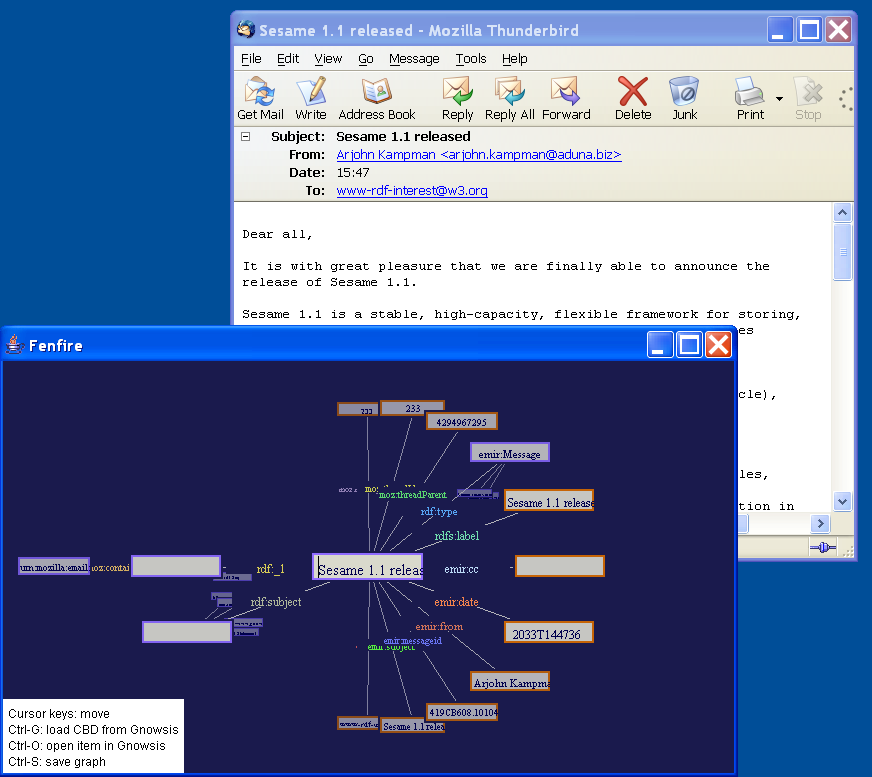
"Gnowsis and Fenfire have met and another time, great Semantic Web developers (aka us) have proven that using ontologies, RDF and web protocols RULEZ. In just a day, two open source projects made substantial integration work."
An early screenshot of Fenfire and Gnowis combining their efforts.
An early screenshot of Fenfire and Gnowis combining their efforts.
Google Scholar
Hits for the Semantic Web gives you that piece in Scientific American. Another interesting one is citations to "The Description Logic Handbook: Theory, Implementation and Applications".
Sesame 1.1
Sesame 1.1 released "Highlights of this release are:
* The Graph API, an extension of Sesame's access APIs, allows fine-grained manipulation of RDF models directly from Java.
* The Native Disk Store is a new storage backend that works directly on the file system, without need for a DBMS. It uses B-Tree indexing on binary files for fast, efficient and scalable storage.
* SeRQL revision 1.1 is a syntax revision that makes SeRQL queries even easier to read and write, and makes embedding in XML easier.
* Blank node handling has dramatically improved compared to 1.0.x.
* Lots of issues related to full Unicode support have been fixed.
* RDF Schema inferencing has been updated to be fully compliant with the W3C RDF Semantics Recommendation.
* Support for MS SQL Server as storage backend RDBMS. Thanks to Adam Skutt for providing fixes and suggestions for this.
* The Rio parser now supports the Turtle serialization format.
* Partial OWL reasoning support through Sesame's custom inferencer.
* Fully updated and extended User Documentation, including code examples for use of the Sesame APIs and a new Troubleshooting and FAQ chapter."
* The Graph API, an extension of Sesame's access APIs, allows fine-grained manipulation of RDF models directly from Java.
* The Native Disk Store is a new storage backend that works directly on the file system, without need for a DBMS. It uses B-Tree indexing on binary files for fast, efficient and scalable storage.
* SeRQL revision 1.1 is a syntax revision that makes SeRQL queries even easier to read and write, and makes embedding in XML easier.
* Blank node handling has dramatically improved compared to 1.0.x.
* Lots of issues related to full Unicode support have been fixed.
* RDF Schema inferencing has been updated to be fully compliant with the W3C RDF Semantics Recommendation.
* Support for MS SQL Server as storage backend RDBMS. Thanks to Adam Skutt for providing fixes and suggestions for this.
* The Rio parser now supports the Turtle serialization format.
* Partial OWL reasoning support through Sesame's custom inferencer.
* Fully updated and extended User Documentation, including code examples for use of the Sesame APIs and a new Troubleshooting and FAQ chapter."
Thursday, November 18, 2004
What's new with Java 6
Sun invites outside involvement with Java 6 "The new version will be easier to manage, exposing information that outside management software can use to make control decisions, said Mark Reinhold, chief J2SE engineer. And it will be easier to find problems, with an "attach-on-demand" feature that can let debugging software graft onto software while it's running instead of just before it's launched.
Another item on the list is support for a basic set of Web services called WS-I, Hamilton said. That basic set, standardized through the Web Services Interoperability organization, had been scheduled for the Tiger release.
And Mustang will have better integration with graphical user interfaces, including Microsoft's upcoming Longhorn version of Windows, Reinhold said. "
Details here.
Another item on the list is support for a basic set of Web services called WS-I, Hamilton said. That basic set, standardized through the Web Services Interoperability organization, had been scheduled for the Tiger release.
And Mustang will have better integration with graphical user interfaces, including Microsoft's upcoming Longhorn version of Windows, Reinhold said. "
Details here.
Tuesday, November 16, 2004
The Problem with Ontologies
The Ontology Problem: A Definition with Commentary" "If the Ontology Integration Problem is not solved it will not be possible to answer a semantic search query across the open Web for a question such as "find all software products that work with Linux and are open-source and are endorsed by people or companies I trust." Why not? Because while there could be tons of raw RDF and OWL instance data out on the Web that is relevant from various ontologies, unless it either all uses the same ontology or all the ontologies that various instances refer to are integrated, the query agent will have no way of making sense of or normalizing the results. Of course, the query agent could simply run the query on all data from all ontologies it knows about, and then just present the results in a single list, sorted by ontology -- but as we've seen above, different ontologies might mean different things by classes with the same names -- and thus the results returned may not really be relevant or well-ordered."
"I believe the solution will ultimately stem from a solution to the Upper Ontology Problem -- if we can solve that problem, then much of the Ontology Integration Problem will go away as most ontologies will automatically be inter-mapped at the Upper-Ontology Level at least. If we had a standard Upper Ontology and furthermore, if this standard were to include concepts for mapping between ontologies and expressing shades semantic mapping and structure between ontological definitions, then mapping would be even easier."
"I believe the solution will ultimately stem from a solution to the Upper Ontology Problem -- if we can solve that problem, then much of the Ontology Integration Problem will go away as most ontologies will automatically be inter-mapped at the Upper-Ontology Level at least. If we had a standard Upper Ontology and furthermore, if this standard were to include concepts for mapping between ontologies and expressing shades semantic mapping and structure between ontological definitions, then mapping would be even easier."
Metadata Driven Component Model
BEA Announces Open-Source Milestones for Apache Beehive "BEA Systems, Inc. (Nasdaq: BEAS - News), a world leader in enterprise infrastructure software, today announced significant milestones in the company's open-source efforts including code release milestones, updated tools and additional platform support for Apache Beehive -- the lightweight metadata-driven component model which is designed to help accelerate the development of service-oriented architectures (SOAs)."
"The M1 code release for the Apache Beehive project is now publicly available for use in both Beehive open-source development and by BEA WebLogic Workshop 8.1 users, and can help developers to begin developing and collaborating on SOA-based applications."
The Apache Beehive Project "This is the project working on making J2EE easier by building a simple object model on J2EE and Struts. The goal is to take the new JSR-175 metadata annotations and use them to reduce the coding necessary for J2EE. The initial Beehive project has three pieces."
Related Pollinate Project " Pollinate is an Eclipse technology project slated to build an Eclipse-based IDE and toolset that leverages the open source Apache Beehive application framework." The PDF slides has some more information on NetUI Page Flows.
Via BEA announces Apache Beehive Milestone
"The M1 code release for the Apache Beehive project is now publicly available for use in both Beehive open-source development and by BEA WebLogic Workshop 8.1 users, and can help developers to begin developing and collaborating on SOA-based applications."
The Apache Beehive Project "This is the project working on making J2EE easier by building a simple object model on J2EE and Struts. The goal is to take the new JSR-175 metadata annotations and use them to reduce the coding necessary for J2EE. The initial Beehive project has three pieces."
Related Pollinate Project " Pollinate is an Eclipse technology project slated to build an Eclipse-based IDE and toolset that leverages the open source Apache Beehive application framework." The PDF slides has some more information on NetUI Page Flows.
Via BEA announces Apache Beehive Milestone
Monday, November 15, 2004
HAVING
One of the features we recently added to iTQL was HAVING. This is practically identical to SQL's use of HAVING. For example:
There are a few things that bother me with this. The first one is the implicit column names. All aggregate functions in iTQL are implicity given $kn. Where n is an integer. The variable name should be able to be set by the user; something like: "SELECT $no_people=COUNT ..." or you could copy the SQL 92 use of AS.
Another one is caused by copying SQL. Putting constraints in the WHERE that were meant for the HAVING will produce an error from an SQL interpreter explaining that certain constraints must be in the HAVING. What this really means is that it could've been done in the WHERE clause and have been automatically extracted if necessary.
Also, the use of double should really be changed to nonNegativeInteger.
A good summary of these first two points are highlighted in a presentation "The Importance of Column Names". It is part of the web site of the new version of "The Third Manifesto".
Here's an example:
In SQL:1992 this is equivalent to:
The Tutorial D version:
SELECT $foo COUNT (SELECT $bar

                   FROM ...

                   WHERE $bar <-> <->)

FROM ...

WHERE $foo <-> <->

HAVING $k0 <tucana:occurs> '1.0'^^<xsd:double> ;
There are a few things that bother me with this. The first one is the implicit column names. All aggregate functions in iTQL are implicity given $kn. Where n is an integer. The variable name should be able to be set by the user; something like: "SELECT $no_people=COUNT ..." or you could copy the SQL 92 use of AS.
Another one is caused by copying SQL. Putting constraints in the WHERE that were meant for the HAVING will produce an error from an SQL interpreter explaining that certain constraints must be in the HAVING. What this really means is that it could've been done in the WHERE clause and have been automatically extracted if necessary.
Also, the use of double should really be changed to nonNegativeInteger.
A good summary of these first two points are highlighted in a presentation "The Importance of Column Names". It is part of the web site of the new version of "The Third Manifesto".
Here's an example:
SELECT D#, COUNT(*)

FROM EMP

GROUP BY D#

HAVING COUNT(*) >= 50
In SQL:1992 this is equivalent to:
SELECT *

FROM ( SELECT D#, COUNT(*) AS NUMBER_OF_EMPS

       FROM EMP

       GROUP BY D# ) AS TEETH_GNASHER

WHERE NUMBER_OF_EMPS >= 50
The Tutorial D version:
( SUMMARIZE EMP  BY { D# } ADD COUNT ( ) AS NUMBER_OF_EMPS )

  WHERE NUMBER_OF_EMPS >= 50
Closing the World
'Closed world' assumptions in RDF "Could we not use the XML declaration attribute standalone to determine that a document is self-contained? As in:
<xml version="1.0" encoding="UTF-8" standalone="yes">
That assumption would possibly elimitate the usefulness of that document in a Semantic Web, but could potentially make the 'open world' issue controllable."
RDF/XML is just one serialization of RDF so modifying the XML doesn't change the RDF contained within. While I don't think you can make RDF be closed world, things like ontologies do let you express "all pigs don't fly" or you can perform a query "do any pigs in this graph fly?" which may have been what you wanted anyway.
<xml version="1.0" encoding="UTF-8" standalone="yes">
That assumption would possibly elimitate the usefulness of that document in a Semantic Web, but could potentially make the 'open world' issue controllable."
RDF/XML is just one serialization of RDF so modifying the XML doesn't change the RDF contained within. While I don't think you can make RDF be closed world, things like ontologies do let you express "all pigs don't fly" or you can perform a query "do any pigs in this graph fly?" which may have been what you wanted anyway.
Manufacturing Semantics
A question of semantics "“I believe the big trend right now in terms of integration of business systems is the movement toward the semantic Web,” says Steven Ray, division chief for the Manufacturing Systems Integration Division (MSID), a division within the National Institute of Standards and Technology (NIST). “The semantic web gives meaning to information—it makes that information formal and acceptable to a computerized system to allow truly intelligent searching.”
According to Ray, the semantic Web is more than a structured database. Today, companies rely on programmers to give meaning to information. For example, if an enterprise resource planning (ERP) company wants to work closely with suppliers to monitor inventory levels, a programmer must complete integration for each new supplier. Over time, this can become quite costly."
"“These standards are the primary building blocks to intelligent and integrated manufacturing,” says Pat Snack, on executive loan from General Motors for AIAG. “We will see a growing need for semantic standards in coming months. The closer we get to end-to-end integrated manufacturing, the more we need to minimize our cost to complexity. It is really a delicate balancing act.”"
According to Ray, the semantic Web is more than a structured database. Today, companies rely on programmers to give meaning to information. For example, if an enterprise resource planning (ERP) company wants to work closely with suppliers to monitor inventory levels, a programmer must complete integration for each new supplier. Over time, this can become quite costly."
"“These standards are the primary building blocks to intelligent and integrated manufacturing,” says Pat Snack, on executive loan from General Motors for AIAG. “We will see a growing need for semantic standards in coming months. The closer we get to end-to-end integrated manufacturing, the more we need to minimize our cost to complexity. It is really a delicate balancing act.”"
Sunday, November 14, 2004
Shortcomings of Spotlight
Tiger's Spotlight - Simplicity with Room for Improvement "While I'm not doubting the success of Apple marketing this as a world-class search tool, from what I know today, there are some shortcomings:
* Only one Importer registrable per File type (.extension) system-wide.
* No daisy-chaining of Importers.
* Very limited amount of data to be stored in dictionary per file.
* No built-in capability to index the content of compressed files like jars, zip, tar etc."
Follows a recent article Apple details plans to Spotlight desktop search. If you want to try something similar there's also Quicksilver which runs on 10.3 and comes with a Spotlight plugin called Flashlight.
* Only one Importer registrable per File type (.extension) system-wide.
* No daisy-chaining of Importers.
* Very limited amount of data to be stored in dictionary per file.
* No built-in capability to index the content of compressed files like jars, zip, tar etc."
Follows a recent article Apple details plans to Spotlight desktop search. If you want to try something similar there's also Quicksilver which runs on 10.3 and comes with a Spotlight plugin called Flashlight.
Annotations and EJB 3.0
EJB 3.0 Preview " The EJB 3.0 specification uses annotations so that you can declare your EJB metadata directly within the bean class.
import javax.ejb.*;
@Stateful
public class ShoppingCartBean implements ShoppingCart
{
@Tx(TxType.REQUIRED) @MethodPermission({"customer"})
public void purchase(Product product, int quantity) {...}
@Remove void emptyCart() {...}
}
The @Stateful annotation marks the ShoppingCartBean as a stateful session bean. @Tx denotes transaction demarcation, while @MethodPermission defines role-based security for the bean method. EJB 3.0 provides annotations for every type of metadata so that no XML descriptor is needed and you can deploy your beans simply by deploying a plain old JAR into your application server."
import javax.ejb.*;
@Stateful
public class ShoppingCartBean implements ShoppingCart
{
@Tx(TxType.REQUIRED) @MethodPermission({"customer"})
public void purchase(Product product, int quantity) {...}
@Remove void emptyCart() {...}
}
The @Stateful annotation marks the ShoppingCartBean as a stateful session bean. @Tx denotes transaction demarcation, while @MethodPermission defines role-based security for the bean method. EJB 3.0 provides annotations for every type of metadata so that no XML descriptor is needed and you can deploy your beans simply by deploying a plain old JAR into your application server."
Friday, November 12, 2004
Never trust a company with a fish tank
EA: The Human Story "...all along the way there were deceptions, there were promises, there were assurances -- there was a big fancy office building with an expensive fish tank -- all of which in the end look like an elaborate scheme to keep a crop of employees on the project just long enough to get it shipped. And then if they need to, they hire in a new batch, fresh and ready to hear more promises that will not be kept; EA's turnover rate in engineering is approximately 50%. This is how EA works. So now we know, now we can move on, right? That seems to be what happens to everyone else. But it's not enough. Because in the end, regardless of what happens with our particular situation, this kind of "business" isn't right, and people need to know about it, which is why I write this today."
That goes for virtual ones too.
The Floggings Will Continue Until Morale Improves "The list could be much longer, but it boils down to:
* Give them the tools to do their job efficiently
* Remove potential interruptions or distractions
* Make sure they’re motivated"
That goes for virtual ones too.
The Floggings Will Continue Until Morale Improves "The list could be much longer, but it boils down to:
* Give them the tools to do their job efficiently
* Remove potential interruptions or distractions
* Make sure they’re motivated"
Always the last to know
NetKernel + Kowari "NetKernel has a great pipes/filters framework for composing services. Kowari is the only non-rdbms backed RDF triple-store with support for queries against datetime data types.
Sadly, building a web application or service in Kowari kinda sucks. But, theoretically, Kowari is embeddable. So I set out to verify this assertion and to gain more knowledge about the inner workings of NetKernel."
"Fourth, NetKernel is really just that, a kernel for managing the interaction and scheduling between components executing in the vm, called modules. But I haven't found support for explicit life-cycle management. That is, there is no init(), start() or stop() type methods on a module. It seems to rely on finalizers to clean up resources. Thus, shutting down a NetKernel instance corrupts the Kowari database."
Like I said in the comments, previously commited data will be there no matter if you kill the process, turn off the power or whatever. However, if you stop it during a load or if autocommit is off it won't be there when restarting.
Sadly, building a web application or service in Kowari kinda sucks. But, theoretically, Kowari is embeddable. So I set out to verify this assertion and to gain more knowledge about the inner workings of NetKernel."
"Fourth, NetKernel is really just that, a kernel for managing the interaction and scheduling between components executing in the vm, called modules. But I haven't found support for explicit life-cycle management. That is, there is no init(), start() or stop() type methods on a module. It seems to rely on finalizers to clean up resources. Thus, shutting down a NetKernel instance corrupts the Kowari database."
Like I said in the comments, previously commited data will be there no matter if you kill the process, turn off the power or whatever. However, if you stop it during a load or if autocommit is off it won't be there when restarting.
New from Google
Coincidentally, Google's Index Size Jumps and Search Engine Size Wars V Erupts "On the eve of Microsoft's long anticipated launch of MSN Search, Google is reporting on its home page that its index size has nearly doubled. Google now claims that it is now "Searching 8,058,044,651 web pages." Earlier today, a search for the word "the" returned nearly 11 billion results, a far larger number than officially reported on the home page. No matter which numbers you believe, it's a significant expansion of Google's web database."
"Microsoft had planned to seize the title of biggest search engine by announcing 5 billion pages indexed today."
And the people at Google "abusing" their power Tweaking the tiger's tail. It's still there. A search for kowari only brings up references to the RDF triple store and not the animal. Google brings up Kowari the animal as the second result.
"Microsoft had planned to seize the title of biggest search engine by announcing 5 billion pages indexed today."
And the people at Google "abusing" their power Tweaking the tiger's tail. It's still there. A search for kowari only brings up references to the RDF triple store and not the animal. Google brings up Kowari the animal as the second result.
Thursday, November 11, 2004
Too many or not enough
The Ontological Challenge "There are several big missing pieces right now in making the semantic web. Certainly the lack of ontologies is a major issue. There are, I guess Deborah would say thousands of ontologies. So there maybe isn't a lack; there may be too many from one perspective. When you start looking at these ontologies, what you find is that some of them are overly specialized; maybe they are focused, for example, on particular niches of interest to DARPA, not particularly of great use to consumers unless you live in New York (with the paranoia that we all experience there)."
"Currently, there is no good human-readable mid-level ontology that's covering common-sense concepts. Cycorp has probably the most impressive ontology. The only problem is it's so big and complex and requires such a high, steep learning curve to actually do anything with it that it's not really targeted at the needs of normal developers and regular end users. The lack of the good, open ontology that covers common-sense concepts is a big problem. That's something we're working on, too. I think that ultimately there ought to be at least something like that that comes out of the W3C or is handed to the W3C at some point to at least provide a basis for describing certain types of entities and relationships that we all have to use in our applications."
"So associating data with ontologies is a problem. Building ontologies, I come from the school of thought of top down. I've never seen a bottom-up ontology that I liked. There aren't many. Having built much of ontologies, I think that the amount of thinking that goes into it is just so intensive that to do it well, I just don't think that, at least without great AI, we'll be able to do it anytime in the next couple of decades."
"Currently, there is no good human-readable mid-level ontology that's covering common-sense concepts. Cycorp has probably the most impressive ontology. The only problem is it's so big and complex and requires such a high, steep learning curve to actually do anything with it that it's not really targeted at the needs of normal developers and regular end users. The lack of the good, open ontology that covers common-sense concepts is a big problem. That's something we're working on, too. I think that ultimately there ought to be at least something like that that comes out of the W3C or is handed to the W3C at some point to at least provide a basis for describing certain types of entities and relationships that we all have to use in our applications."
"So associating data with ontologies is a problem. Building ontologies, I come from the school of thought of top down. I've never seen a bottom-up ontology that I liked. There aren't many. Having built much of ontologies, I think that the amount of thinking that goes into it is just so intensive that to do it well, I just don't think that, at least without great AI, we'll be able to do it anytime in the next couple of decades."
Wednesday, November 10, 2004
Welkin
Welkin: A General-Purpose RDF Browser "Many consider the Semantic Web to be vaporware and others believe it's the next big thing. No matter where you stand, a question always pops up: Where is the RDF browser? The SIMILE Project, a joint project between W3C, MIT and HP to implement semantic interoperability of metadata in digital libraries, released today the first beta release of a general purpose graphic and interactive RDF browser named Welkin (see a screenshot), targetted to those who need to get a mental model of any RDF dataset, from a single RSS 1.0 news feed to a collection of digital data."
Welkin Homepage.
Welkin Homepage.
Creative RDF in Queensland
Creative Commons taking shape in Australia "The Australian branch of the Creative Commons is taking shape with the Queensland University of Technology being the lead agency, according to Professor Brian Fitzgerald, head of the university's law school.
In February this year, QUT became the Australian institutional affiliate for the project and over the last few months it has worked closely with the legal firm Blake Dawson Waldron to set up the platform for the project in Australia.
The University is holding a conference in January next year on Open content licensing, and has invited Stanford University Law Professor Lawrence Lessig, one of the directors of the Creative Commons, as its keynote speaker."
In February this year, QUT became the Australian institutional affiliate for the project and over the last few months it has worked closely with the legal firm Blake Dawson Waldron to set up the platform for the project in Australia.
The University is holding a conference in January next year on Open content licensing, and has invited Stanford University Law Professor Lawrence Lessig, one of the directors of the Creative Commons, as its keynote speaker."
6 months with Java 5
"I have been writing JDK 5.0 code for over six months now, so I thought I would take some time to reflect on my experience and draw a few conclusions on the features that were introduced."
Surprisingly the favourite, is the enhanced for loop:
"The undisputed winner. I can't even begin to describe how good it feels to use the new for loop everywhere (well, almost everywhere). I mentally cringe the few times when I am forced to use the old for loop, typically when I need the index or that I want the Iterator to be visible outside the loop."
Unsurprisingly annotations gets a rave:
"Obviously, I am partial to annotations since they are at the heart of TestNG but I am a firm believer that annotations are going to change the way we build software in Java. We have been relying for far too long on reflection hacks to introduce meta-data in our programs, and annotations are finally going to provide an excellent solution to this problem.
Also, I haven't felt the need to use some of the predefined annotations such as @Override, so I haven't formed an opinion on them yet.
It seems inescapable to me that in a couple of years, most of the Java code that we will be reading and writing will contain annotations. "
And generics:
"In a nutshell, I have this to say about Java generics: my code feels more robust, but it's harder to read."
JDK 5 in Practice.
Also an interview with one of the authors of Hibernate:
"Well, we are a bit stuck. We can't use many of the new features, because Hibernate needs to stay source-level compatible with older JDKs. The annotations stuff is okay, because we can provide it as an add-on package.
Certainly, annotations are the most significant new feature of Java 5, and it's very likely that they will completely change the way we write code."
Surprisingly the favourite, is the enhanced for loop:
"The undisputed winner. I can't even begin to describe how good it feels to use the new for loop everywhere (well, almost everywhere). I mentally cringe the few times when I am forced to use the old for loop, typically when I need the index or that I want the Iterator to be visible outside the loop."
Unsurprisingly annotations gets a rave:
"Obviously, I am partial to annotations since they are at the heart of TestNG but I am a firm believer that annotations are going to change the way we build software in Java. We have been relying for far too long on reflection hacks to introduce meta-data in our programs, and annotations are finally going to provide an excellent solution to this problem.
Also, I haven't felt the need to use some of the predefined annotations such as @Override, so I haven't formed an opinion on them yet.
It seems inescapable to me that in a couple of years, most of the Java code that we will be reading and writing will contain annotations. "
And generics:
"In a nutshell, I have this to say about Java generics: my code feels more robust, but it's harder to read."
JDK 5 in Practice.
Also an interview with one of the authors of Hibernate:
"Well, we are a bit stuck. We can't use many of the new features, because Hibernate needs to stay source-level compatible with older JDKs. The annotations stuff is okay, because we can provide it as an add-on package.
Certainly, annotations are the most significant new feature of Java 5, and it's very likely that they will completely change the way we write code."
The problem with SOAP
Web Services - The SCRAM Generation "SOAP - the bedrock of our industry's plans for universal interoperability. The cornerstone of enterprise mission-critical integration."
"SOAP - a communications protocol that does not guarantee delivery of messages, does not guarantee what order those messages will be delivered in, and does not guarantee not to throw in extra messages, just for the fun of it. Now to be fair, SOAP is only half of the problem. The other half is the communications channel itself, which is typically HTTP."
"SCRAM stands for Secure, Coordinated, Reliable Asynchronous Messaging"
"SOAP - a communications protocol that does not guarantee delivery of messages, does not guarantee what order those messages will be delivered in, and does not guarantee not to throw in extra messages, just for the fun of it. Now to be fair, SOAP is only half of the problem. The other half is the communications channel itself, which is typically HTTP."
"SCRAM stands for Secure, Coordinated, Reliable Asynchronous Messaging"
SPARQL Protocol
SPARQL Protocol for RDF "This document describes SPARQL, a protocol for accessing RDF data and for conveying RDF queries from query clients to query processors. The SPARQL Protocol has been designed for compatability with the SPARQL Query Language for RDF but is designed to convey queries from other RDF query languages as well."
"The SPARQL abstract protocol has three parts: types, operations, and responses."
"The abstract protocol uses the following types, which fall into three categories: W3C XML Schema types, which are relevant to all abstract protocol operations and borrowed from W3C XML Schema Datatypes; protocol types, which are relevant to abstract protocol operations; and query types, which are relevant to query operations."
"The SPARQL Abstract Protocol defines three kinds of response: success, fault, and informational. Success responses indicate that the protocol operation was successfully executed; fault responses indicate that the protocol operation was not successfully executed; informational responses either provide additional information about an abstract protocol operation or describe specific conditions relevant to particular abstract protocol operations."
"The SPARQL Abstract Protocol is made up of seven orthogonal operations: query, getGraph, getOptions, makeGraph, dropGraph, addTriples, and deleteTriples."
"The SPARQL abstract protocol has three parts: types, operations, and responses."
"The abstract protocol uses the following types, which fall into three categories: W3C XML Schema types, which are relevant to all abstract protocol operations and borrowed from W3C XML Schema Datatypes; protocol types, which are relevant to abstract protocol operations; and query types, which are relevant to query operations."
"The SPARQL Abstract Protocol defines three kinds of response: success, fault, and informational. Success responses indicate that the protocol operation was successfully executed; fault responses indicate that the protocol operation was not successfully executed; informational responses either provide additional information about an abstract protocol operation or describe specific conditions relevant to particular abstract protocol operations."
"The SPARQL Abstract Protocol is made up of seven orthogonal operations: query, getGraph, getOptions, makeGraph, dropGraph, addTriples, and deleteTriples."
Monday, November 08, 2004
The time for change
J2EE5, EJB3 and microcontainers "Today, java has support for annotation since JDK5.0. We are already using it to transform the way we think about, design, implement and indeed standardize middleware in the next generations of J2EE. Where J2EE has a big edge over .NET is first in a large installed base but most importantly in the quality of the services."
"We have been doing the right thing in the spec committees, namely simplifying the programming models to support POJO and annotations at the specification level by leveraging JDK5.0. Across the board in EJB3 for example, we have completely revamped and simplified the way developers interface with and program to middleware. Instead of complex API's and tons of XML, developers can tag their objects with annotations. Developers have already adopted this approach."
"EJB3 will have a long life, as it is the first to introduce this long awaited microcontainer, lightweight programming view of the world. EJB services can now be used on J2SE with these microcontainers."
"All of this is already used in production, today. Many vendors are on the market, many packages await branding standardization for further penetration of the market. J2EE will remain strong."
"We have been doing the right thing in the spec committees, namely simplifying the programming models to support POJO and annotations at the specification level by leveraging JDK5.0. Across the board in EJB3 for example, we have completely revamped and simplified the way developers interface with and program to middleware. Instead of complex API's and tons of XML, developers can tag their objects with annotations. Developers have already adopted this approach."
"EJB3 will have a long life, as it is the first to introduce this long awaited microcontainer, lightweight programming view of the world. EJB services can now be used on J2SE with these microcontainers."
"All of this is already used in production, today. Many vendors are on the market, many packages await branding standardization for further penetration of the market. J2EE will remain strong."
No-Nonsense Semantic Web Part II
A No-nonsense Guide to Semantic Web Specs for XML People "I was going to talk about RDQL in this article, but on Oct. 12, the Data Access Working Group (DAWG, pronounced so that it rhyms with 'dog') released the first working draft of Sparql, the query language for RDF."
"So, as a result, the query will return the title and the price of items where the price is less than 30.
Big deal, I hear you saying. I can do that today in SQL.
True, you can. If your data is local and you control it. But what if you want a software agent to do the queries for you? How are you going to find out across different databases how to adapt your query to their own internal logic, to their tables and to the way thay modeled the information in their relational model?"
"So, in short: should you care about RDF? For now, you are safe if you care about keeping your own data valid and coherent. The semantic web is trying hard to unlock the chicken-egg problem of "no killer app until data, no data until killer app" and automatic trasnformation of existing data into RDF is what I think is going to unlock it. Also, the fact that we are building tools that you can now use to operate on your RDF data, for example to browse and search it, will show you what you can gain by making those relationships explicit."
"So, as a result, the query will return the title and the price of items where the price is less than 30.
Big deal, I hear you saying. I can do that today in SQL.
True, you can. If your data is local and you control it. But what if you want a software agent to do the queries for you? How are you going to find out across different databases how to adapt your query to their own internal logic, to their tables and to the way thay modeled the information in their relational model?"
"So, in short: should you care about RDF? For now, you are safe if you care about keeping your own data valid and coherent. The semantic web is trying hard to unlock the chicken-egg problem of "no killer app until data, no data until killer app" and automatic trasnformation of existing data into RDF is what I think is going to unlock it. Also, the fact that we are building tools that you can now use to operate on your RDF data, for example to browse and search it, will show you what you can gain by making those relationships explicit."
Thursday, November 04, 2004
Parallel Countries
The similarities between the Australian and American political situation was recently highlighted by "Bush & Howard: parallel lives"
"As John Howard ponders the likely return of George Bush, he will no doubt be struck by the parallels between the President's probable re-election and his own emphatic victory last month."
Similarities:
* Both have control in the upper and lower houses to pass laws as long as they can maintain party lines.
* Running trade deficits - Australian Trade Deficit Widens as Imports Increase
* Banning abortion.
Sarah Maddison: Minister mistakes opinion for fact.
* Increasing surveillance powers. Ruddock relaunches terror laws.
* Tax cuts for the higher tax brackets.
Howard flags new tax cuts
* Reducing gay rights. THE COALITION PLANS TO REINTRODUCE LEGISLATION BANNING SAME-SEX COUPLES FROM OVERSEAS ADOPTION NOW IT HAS CONTROL OF THE SENATE.
* Environment. We won't Sign Kyoto Treaty, Says Australia
"As John Howard ponders the likely return of George Bush, he will no doubt be struck by the parallels between the President's probable re-election and his own emphatic victory last month."
Similarities:
* Both have control in the upper and lower houses to pass laws as long as they can maintain party lines.
* Running trade deficits - Australian Trade Deficit Widens as Imports Increase
* Banning abortion.
Sarah Maddison: Minister mistakes opinion for fact.
* Increasing surveillance powers. Ruddock relaunches terror laws.
* Tax cuts for the higher tax brackets.
Howard flags new tax cuts
* Reducing gay rights. THE COALITION PLANS TO REINTRODUCE LEGISLATION BANNING SAME-SEX COUPLES FROM OVERSEAS ADOPTION NOW IT HAS CONTROL OF THE SENATE.
* Environment. We won't Sign Kyoto Treaty, Says Australia
SWOOP 2.2 beta 3
SWOOP
New Features:
"1. Integrated Annotea Client for writing and sharing annotations on
any ontology/class/property/individual. (see Advanced->Annotea) - you
can attach and distribute ontology change sets as well
2. Ontology debugging support (check Debug) through better
explanations via Pellet, and highlighting inconsistent classes / class
expressions.
There are a bunch of minor new features (e.g. improved lookup, manual
checkpoints, more XSD support etc), UI improvements (esp. w.r.t adding
new entities, restrictions and Abstract Syntax/Turtle renderers), and
plenty of bug fixes, all noted in readme.txt."
SWOOP v2.2 beta 3 released
Screenshots of versioning and inline Koalas.
New Features:
"1. Integrated Annotea Client for writing and sharing annotations on
any ontology/class/property/individual. (see Advanced->Annotea) - you
can attach and distribute ontology change sets as well
2. Ontology debugging support (check Debug) through better
explanations via Pellet, and highlighting inconsistent classes / class
expressions.
There are a bunch of minor new features (e.g. improved lookup, manual
checkpoints, more XSD support etc), UI improvements (esp. w.r.t adding
new entities, restrictions and Abstract Syntax/Turtle renderers), and
plenty of bug fixes, all noted in readme.txt."
SWOOP v2.2 beta 3 released
Screenshots of versioning and inline Koalas.


Martin Fowler on OOPSLA 2004
OOPSLA2004 "Four patterns were voted off. Factory Method (due to the confusion over what it means - the pattern is different to the more common usage of the term), Bridge, Flyweight, and Interpreter. Two patterns, Singleton and Chain of Responsibility, were split decisions.
I found the votes and discussions interesting. Of course it's hard to really consider this without looking at alternatives. I was surprised that Singleton got away with a split decision, considering how unpopular it's become amongst my friends. Most of the others were voted off because people felt they were sufficiently uncommon and that other patterns would probably take their place, sadly we didn't have time to consider new members."
"Steve McConnell opened up day two. His talk focused on the ten year gap between the first and second edition of his excellent book Code Complete. Brian Foote summed it up as a "litany of things I agreed with". My sum up would be that the industry has made real progress in this area during the last decade, despite the usual views of skies falling in around us."
"Attacking software-as-manufacturing was particularly timely since every OOPSLA attendee got a copy of Software Factories in their goody bag. I've been aware of this work for a while, and my instinctive allergy to this metaphor was only reinforced by the "we need industrialization" motivations. Dig deeper, however, and there are good ideas in here - particularly the approach of integrated DomainSpecificLanguage capabilities."
It's good to see this was discussed as the two books I recently acquired were "Code Complete" and "Software Factories".
I found the votes and discussions interesting. Of course it's hard to really consider this without looking at alternatives. I was surprised that Singleton got away with a split decision, considering how unpopular it's become amongst my friends. Most of the others were voted off because people felt they were sufficiently uncommon and that other patterns would probably take their place, sadly we didn't have time to consider new members."
"Steve McConnell opened up day two. His talk focused on the ten year gap between the first and second edition of his excellent book Code Complete. Brian Foote summed it up as a "litany of things I agreed with". My sum up would be that the industry has made real progress in this area during the last decade, despite the usual views of skies falling in around us."
"Attacking software-as-manufacturing was particularly timely since every OOPSLA attendee got a copy of Software Factories in their goody bag. I've been aware of this work for a while, and my instinctive allergy to this metaphor was only reinforced by the "we need industrialization" motivations. Dig deeper, however, and there are good ideas in here - particularly the approach of integrated DomainSpecificLanguage capabilities."
It's good to see this was discussed as the two books I recently acquired were "Code Complete" and "Software Factories".
Mobile Semantic Web
A Mobile Web That Knows All About You "MyCampus consists of several task-specific agents that automatically capture contextual information. Each MyCampus user has a database, called a "Semantic eWallet," which is a repository for users' personal information, such as class schedules, list of friends and classmates, and lifestyle and event preferences. Location data is generated using Pango's WiFi access-point triangulation. All the data is marked with Semantic metadata so that MyCampus agents can make use of it. User's can set access privileges to allow certain people to know where they are at any given moment, or what their schedule for the upcoming week is."
It uses some projects I haven't heard of before OWL inference engine using XSLT and JESS and ROWL: Rule Language in OWL and Translation Engine for JESS.
Via Semantic Web on mobile devices
It uses some projects I haven't heard of before OWL inference engine using XSLT and JESS and ROWL: Rule Language in OWL and Translation Engine for JESS.
Via Semantic Web on mobile devices
PsychiatryOnline to use Silverchair Content Manager
American Psychiatric Publishing Partners With Silverchair to Develop DSM-IV-TR and PsychiatryOnline "With the early 2005 launch of PsychiatryOnline, the complete content of DSM-IV-TR® -- the world's most widely used psychiatric reference -- will be integrated with other essential psychiatry resources through Silverchair Content Manager(TM)(SCM) -- Silverchair's semantic Web platform for clinical references. PsychiatryOnline will provide mental health professionals with comprehensive, intuitive access to the world's leading references..."
That's the little "s" semantic Web, it's not using RDF but just XML based technologies.
That's the little "s" semantic Web, it's not using RDF but just XML based technologies.
A bit of left thinking
As conservative politicians continue to hold power across the world another left vs right debate has been brought up.
Driving on the umm, Right "If human society is of predominantly right-handed people and right-handers tend to the right, then I think Britain got it wrong; we should all drive on the right."
Why do the English drive on the "wrong" side of the road? "In days of old logic dictated that when people passed each other on the road they should be in the best possible position to use their sword to protect themselves. As most people are right handed they therefore keep to their left. This practice was formalised in a Papal Edict by Pope Benefice around 1300AD who told all his pilgrims to keep to the left."
As usual, America copied off the French:
"The connection with the USA is thought to be General Lafayette who recommended a keep right rule as part of the help that he gave the Americans in the build up to the war of Independence. The first reference to keep right in USA law is in a rule covering the Lancaster to Philadelphia turnpike in 1792."
Which side of the road do they drive on? Has a map of Left vs Right, a section on pedistrian movement and lists a place in America where they drive on the left: "There is a rather dramatic segment of Interstate 5 where one drives on the left. It is on the Five Mile Grade coming into the Los Angeles area from the north. Because there are four lanes going in each direction, the separation is several miles long, and the two roadways are on opposite sides of a canyon, the effect is quite impressive."
Driving on the umm, Right "If human society is of predominantly right-handed people and right-handers tend to the right, then I think Britain got it wrong; we should all drive on the right."
Why do the English drive on the "wrong" side of the road? "In days of old logic dictated that when people passed each other on the road they should be in the best possible position to use their sword to protect themselves. As most people are right handed they therefore keep to their left. This practice was formalised in a Papal Edict by Pope Benefice around 1300AD who told all his pilgrims to keep to the left."
As usual, America copied off the French:
"The connection with the USA is thought to be General Lafayette who recommended a keep right rule as part of the help that he gave the Americans in the build up to the war of Independence. The first reference to keep right in USA law is in a rule covering the Lancaster to Philadelphia turnpike in 1792."
Which side of the road do they drive on? Has a map of Left vs Right, a section on pedistrian movement and lists a place in America where they drive on the left: "There is a rather dramatic segment of Interstate 5 where one drives on the left. It is on the Five Mile Grade coming into the Los Angeles area from the north. Because there are four lanes going in each direction, the separation is several miles long, and the two roadways are on opposite sides of a canyon, the effect is quite impressive."
Wednesday, November 03, 2004
AntFlow
AntFlow: Hotfolder Driven Workflow and Automation based on Ant "AntFlow builds upon Apache Ant to provide a new approach to simplifying system automation that uses pipelines of hot folders chained together to perform a given task...Hot Folder Triggers - AntFlow allows users to automate processes based on a file being added or changed within a folder on disk. This provides an intuitive and user-friendly way for end-users to interact with applications and can greatly simplify integration between applications that can output and injest files."
A related article, Patterns and Strategies for Building Document-Based Web Services.
A related article, Patterns and Strategies for Building Document-Based Web Services.
The Greatest Democracy of All
What the U.S. can learn from India's electronic voting machines. "While we in the United States agonize over touch screens and paper trails, India managed to quietly hold an all-electronic vote. In May, 380 million Indians cast their votes on more than 1 million machines. It was the world's largest experiment in electronic voting to date and, while far from perfect, is widely considered a success. How can an impoverished nation like India, where cows roam the streets of the capital and most people's idea of high-tech is a flush toilet, succeed where we have not?"
"Unlike the machines used in the United States, the Indian machines are not networked. Each one has to be physically carried to a central counting center. This takes more time, of course, but reduces the opportunities for mischief. Someone who wanted to throw the election would have to fiddle with thousands of machines, one at a time."
"Or, as the Russians might put it: Why build a million-dollar pen when a pencil will do?"
Another site, E-Voting News and Analysis, from the Experts lists the current problems occurring in the various US states.
It seems weird that the US votes on a weekday. In Australia they picked the election day so that it didn't conflict with the football finals.
"Unlike the machines used in the United States, the Indian machines are not networked. Each one has to be physically carried to a central counting center. This takes more time, of course, but reduces the opportunities for mischief. Someone who wanted to throw the election would have to fiddle with thousands of machines, one at a time."
"Or, as the Russians might put it: Why build a million-dollar pen when a pencil will do?"
Another site, E-Voting News and Analysis, from the Experts lists the current problems occurring in the various US states.
It seems weird that the US votes on a weekday. In Australia they picked the election day so that it didn't conflict with the football finals.
Monday, November 01, 2004
Predicate Dispatch
JPred: Practical Predicate Dispatch for Java "With predicate dispatch, a method implementation may specify an arbitrary predicate as a guard. A method m1 overrides another method m2 if m1’s predicate logically implies m2’s predicate. Ernst et al. provide a number of examples illustrating how predicate dispatch unifies and generalizes several existing language concepts, including ordinary OO dynamic dispatch, multimethod dispatch, and functional-style pattern matching."
"JPred augments the Java language by allowing each method declaration to optionally include a clause of the form when pred, just before the optional throws clause. The predicate expression pred is a boolean expression specifying the conditions under which the method may be invoked."
"While a traditional multimethod is expressed in JPred as a predicate consisting of a conjunction of specializer expressions on formals, JPred also allows arbitrary disjunctions and negations."
"Finally, a notion of resend [13, 37], which generalizes Java’s super to walk up JPred’s method-overriding partial order, could be useful to allow predicate methods within a class to easily share code."
"JPred augments the Java language by allowing each method declaration to optionally include a clause of the form when pred, just before the optional throws clause. The predicate expression pred is a boolean expression specifying the conditions under which the method may be invoked."
"While a traditional multimethod is expressed in JPred as a predicate consisting of a conjunction of specializer expressions on formals, JPred also allows arbitrary disjunctions and negations."
"Finally, a notion of resend [13, 37], which generalizes Java’s super to walk up JPred’s method-overriding partial order, could be useful to allow predicate methods within a class to easily share code."
Friday, October 29, 2004
OntoBuilder
DG Research Team Is Developing a Digital Interpreter "One of the first steps in the process is the creation of an ontology, a cross-lingual thesaurus that provides a thematic structure for all the terms one is likely to encounter. Ontologies need to be semantically sensitive: "bank" near "river" means something quite different from "bank" near "teller."
"In the context of Digital Government, ontologies play an increasingly important role, as database metadata schemas, terminology standardization structures and the foundation for interfaces between applications," says Hovy. "Yet the complexity and cost of building ontologies remains a daunting challenge.""
"Since ontologies are such a necessary and time-consuming precursor to any integration project, researchers are investigating, "semi-automated methods to build ontologies to align and merge existing ones for new purposes and to adapt old ones for re-use," says Hovy, who hopes this will become a prototype project for just such semi-automation technology."
OntoBuilder was covered previously, it's Java based, and is mentioned in the Ontology Tools Survey, Revisited.
"In the context of Digital Government, ontologies play an increasingly important role, as database metadata schemas, terminology standardization structures and the foundation for interfaces between applications," says Hovy. "Yet the complexity and cost of building ontologies remains a daunting challenge.""
"Since ontologies are such a necessary and time-consuming precursor to any integration project, researchers are investigating, "semi-automated methods to build ontologies to align and merge existing ones for new purposes and to adapt old ones for re-use," says Hovy, who hopes this will become a prototype project for just such semi-automation technology."
OntoBuilder was covered previously, it's Java based, and is mentioned in the Ontology Tools Survey, Revisited.
Thursday, October 28, 2004
More ISWC Papers
The previous posting I made on scalable OWL seems to have been very popular and the Semantic Web Interest Group IRC Scratchpad posted links to all the papers at ISWC 2004 Annotations. Sadly, I'm impressed that, under Safari, the title has a drop shadow that is done using stylesheets. More information, Text-Shadow in Safari 1.1.
The U in URI
A couple of interesting postings which seems to have a common theme:
* First in a series of five postings on the "W3C Semantic Web in Life Sciences Workshop", TBL Keynote at W3C Semantic Web in Life Sciences Workshop "True to form, Sir Tim ensured that everyone present understood that they should all use URIs for everything. I wonder what his sock drawer looks like. His example was to define a URI for a concept like "colour"...Tim was asked where to find a browser for the Semantic Web (again). The difference this year is that there is starting to be a good answer to that question. Have a look at (Longwell) and (Haystack). He also pointed to ( Ontaria, which is more of a directory than a browser..."
* Tim Berners-Lee on the Failure of URIs as Identifiers in RDF, Faulty URIs, Identifiers: Uniform Resource Identifier (URI).
* Learn About Haystack: The Universal Information Client
* First in a series of five postings on the "W3C Semantic Web in Life Sciences Workshop", TBL Keynote at W3C Semantic Web in Life Sciences Workshop "True to form, Sir Tim ensured that everyone present understood that they should all use URIs for everything. I wonder what his sock drawer looks like. His example was to define a URI for a concept like "colour"...Tim was asked where to find a browser for the Semantic Web (again). The difference this year is that there is starting to be a good answer to that question. Have a look at (Longwell) and (Haystack). He also pointed to ( Ontaria, which is more of a directory than a browser..."
* Tim Berners-Lee on the Failure of URIs as Identifiers in RDF, Faulty URIs, Identifiers: Uniform Resource Identifier (URI).
* Learn About Haystack: The Universal Information Client
Wednesday, October 27, 2004
Isolation
ACID is Good "Unfortunately, ACID transactions do not work effectively over a long period of time. Do not expect things to work if your transactions last more than even a few seconds...This is the so-called “long transaction problem”. No one has found a solution for it after many years of research. The basic problem is achieving isolation – the “I” in “ACID”. There are no known concurrency control algorithms that will operate over a long period of time."
"Over the years, several techniques have been proposed for managing long-lived activities. One of the first is called a Saga. [GGKKS] Sagas require you to define compensating transactions. A compensating transaction compensates for the effects of a transaction. For example, a compensating transaction for reserving a hotel room would be a transaction that cancels the reservation."
"Therefore, rather than provide support for a single model, such as Sagas, JSR 95 defines an infrastructure to support a wide range of extended transaction models. The architecture is based on the insight that the various extended transaction models can be supported by providing a general purpose event signaling mechanism that can be programmed to enable activities (application specific units of computations) to coordinate each other in a manner prescribed by the extended transaction model under consideration."
The read phases in Kowari/TKS can work over days without interrupting other phases. I've been meaning to try and explain its isolation level which is somewhere between 2 and 3. Reads don't interact with locking but writes are serialized. It doesn't prevent phantom reads but it does mean that querying graphs and getting sub-graphs will always be consistent - i.e. as you constrain it further you always get fewer results.
"Over the years, several techniques have been proposed for managing long-lived activities. One of the first is called a Saga. [GGKKS] Sagas require you to define compensating transactions. A compensating transaction compensates for the effects of a transaction. For example, a compensating transaction for reserving a hotel room would be a transaction that cancels the reservation."
"Therefore, rather than provide support for a single model, such as Sagas, JSR 95 defines an infrastructure to support a wide range of extended transaction models. The architecture is based on the insight that the various extended transaction models can be supported by providing a general purpose event signaling mechanism that can be programmed to enable activities (application specific units of computations) to coordinate each other in a manner prescribed by the extended transaction model under consideration."
The read phases in Kowari/TKS can work over days without interrupting other phases. I've been meaning to try and explain its isolation level which is somewhere between 2 and 3. Reads don't interact with locking but writes are serialized. It doesn't prevent phantom reads but it does mean that querying graphs and getting sub-graphs will always be consistent - i.e. as you constrain it further you always get fewer results.
Tuesday, October 26, 2004
Scalable OWL Lite
An Evaluation of Knowledge Base Systems for Large OWL Datasets "In this paper, we present an evaluation of four knowledge base systems (KBS) with respect to use in large OWL applications."
"DLDB-OWL [23], is a repository for processing, storing, and querying large amounts of OWL data. Its major feature is the extension of a relational database system with description logic inference capabilities. Specifically, DLDBOWL uses Microsoft Access® as the DBMS and FaCT [16] as the OWL reasoner. It uses the reasoner to precompute subsumption and employs relational views to answer extensional queries based on the implicit hierarchy that is inferred."
"...we were surprised to see that Sesame-Memory could load up to 10 universities, and was able to do it in 5% of the time of the next fastest system. However, for 20 or more universities, Sesame-Memory also succumbed to memory limitations...The result reveals an apparent problem for Sesame-DB: it does not scale in data loading...As an example, it took over 300 times longer to load the 20-university data set than the 1-university data set, although the former set contains only about 25 times more instances than the later...Sesame is a forward-chaining reasoner, and in order to support statement deletions it uses a truth maintenance system to track all deductive dependencies between statements."
"From our analysis, of the systems tested: DLDB is the best for large data sets where an equal emphasis is placed on query response time and completeness."
Lehigh University Benchmark.
"DLDB-OWL [23], is a repository for processing, storing, and querying large amounts of OWL data. Its major feature is the extension of a relational database system with description logic inference capabilities. Specifically, DLDBOWL uses Microsoft Access® as the DBMS and FaCT [16] as the OWL reasoner. It uses the reasoner to precompute subsumption and employs relational views to answer extensional queries based on the implicit hierarchy that is inferred."
"...we were surprised to see that Sesame-Memory could load up to 10 universities, and was able to do it in 5% of the time of the next fastest system. However, for 20 or more universities, Sesame-Memory also succumbed to memory limitations...The result reveals an apparent problem for Sesame-DB: it does not scale in data loading...As an example, it took over 300 times longer to load the 20-university data set than the 1-university data set, although the former set contains only about 25 times more instances than the later...Sesame is a forward-chaining reasoner, and in order to support statement deletions it uses a truth maintenance system to track all deductive dependencies between statements."
"From our analysis, of the systems tested: DLDB is the best for large data sets where an equal emphasis is placed on query response time and completeness."
Lehigh University Benchmark.
Network Inference gets $8.1 million
Network Inference Announces $8.1 Million in New Funding "Network Inference, the leading provider of standards-based adaptive software infrastructure, today announced the first quarter 2004 close of $8.1 million as part of its Series B venture capital funding round."
In Search of Mosaic for the SW
Mining the Semantic Web "You've got to have ontologies; you've got to have a language for doing it; you need a social networking mechanism to enable you to make these inferences between representations that people are putting up about themselves. And you need a higher layer that actually crawls or somehow gathers that data and integrates it behind a single interface.
Today we have this new generation of technology. We don't really even have a browser for this information. There are some standards that have just come out, and we're at the stage now where there's no Yahoo. There's not even a Mosaic. There's definitely no Netscape. The question will be really who is in position to make these critical, enabling first key pieces of technology that will catalyze the rest of it."
"Where we're going is to take the hundreds of thousands of real-time news feeds today—going on millions—and turn it into broad search. The way we look at RSS is it's everything on the web that changes, which is to say everything on the web that has value."
Today we have this new generation of technology. We don't really even have a browser for this information. There are some standards that have just come out, and we're at the stage now where there's no Yahoo. There's not even a Mosaic. There's definitely no Netscape. The question will be really who is in position to make these critical, enabling first key pieces of technology that will catalyze the rest of it."
"Where we're going is to take the hundreds of thousands of real-time news feeds today—going on millions—and turn it into broad search. The way we look at RSS is it's everything on the web that changes, which is to say everything on the web that has value."
Slides for Urchin and Kowari
NPG and the Semantic Web, Urchin and Kowari
"Urchin:
* RSS Aggregator which represents all feeds in RDF
* Written in Perl
Kowari:
* Specialized RDF database
* Written in Java
Urchin-Kowari:
* Replace Perl's RCQL with Tucana's iTQL query
* The interface is otherwise unchanged
* Urchin and Kowari are connected via SOAP"
"Urchin:
* RSS Aggregator which represents all feeds in RDF
* Written in Perl
Kowari:
* Specialized RDF database
* Written in Java
Urchin-Kowari:
* Replace Perl's RCQL with Tucana's iTQL query
* The interface is otherwise unchanged
* Urchin and Kowari are connected via SOAP"
P2P Review
The Networked Semantic Desktop "In the first phase, Semantic Web, P2P, and Social Networking technologies are developed, researched and partially deployed. In the second stage, we will see convergence: Semantic Web technology is deployed on the Desktop, resulting in the Semantic Desktop. Similarly, Semantic Web technology is incorporated in P2P networks and Social Networking. Once there is a reliable technology available for the technology convergences, the next phase can be tackled: the combination of the three fields Semantic Desktop, Semantic P2P and ontology-driven Social Networking into the Networked Semantic Desktop."
Via Post details: Networked Semantic Desktop.
Via Post details: Networked Semantic Desktop.
Information Architecture
Metadata? Thesauri? Taxonomies? Topic Maps! "Information architects have so far applied known and well-tried tools from library science to solve this problem, and now topic maps are sailing up as another potential tool for information architects. This raises the question of how topic maps compare with the traditional solutions, and that is the question this paper attempts to address."
Offers a good introduction to the ideas of taxonomies, ontologies, faceted classification, controlled vocabularies, and of course, topic maps.
Offers a good introduction to the ideas of taxonomies, ontologies, faceted classification, controlled vocabularies, and of course, topic maps.
XP vs RUP
XP vs RUP "The main reason is that I think XP focus is the correct one: Simplicity, feedback, embracing change, people developing quality software that works. XP has a positive perspective on software development, putting trust before control. Furthermore, many tools for quality assurance, testing, reporting, and continuous integration have emerged from the XP community."
Monday, October 25, 2004
Interception
Using Spring AOP to Implement the Cuckoo's Egg Design Pattern "This article has shown how to carefully use the active around form of advice inside of the Spring framework. The around form of advice is commonly used when implementing the Cuckoo's Egg design pattern, and so you were shown one example of how this aspect-oriented design pattern can be implemented using Spring AOP."
Sunday, October 24, 2004
Apple in the Enterprise
Apple's Stupidity - Not Supporting "Third Party" User Space Applications That Cause Kernel Panics "...when Qmail is spam bombed with a flood of emails, the system suffers a kernel panic. Yet, this problem only occurs on dual processor machines! Apple's lovely suggestion - "Oh, just disabled the second processor...Under no circumstances should a userspace application cause the kernel to panic. On Unix, this is just plain unacceptable and represents an issue with something in the kernel or core libraries. Basically, you are saying that any end user has the ability to crash the machine. For example, if I have an account on a Mac OS X box, I can compile qmail and bind it to an unprivileged port. At that point, I can flood the machine with enough requests to crash the system."
That's exactly what we've seen with Kowari/TKS. I like developing on an Apple system, sure it's slow and Apple keep tying upgrades of the JVM to the OS but it's those other productivity benefits that make it worthwhile.
That's exactly what we've seen with Kowari/TKS. I like developing on an Apple system, sure it's slow and Apple keep tying upgrades of the JVM to the OS but it's those other productivity benefits that make it worthwhile.
Recent Java 1.5 Articles
* To Annotate or Not? "...when the goal is really about adding layers of metadata on top of the source and that applies uniquely to specific code elements, metadata in Java should fill the bill perfectly. The ability to supply the metadata at the same time and locality as the code increases ease of development. Not only is development made easier but the processing is also much simpler, because the object model is defined by the annotation type definitions themselves."
* GETTING TO KNOW SYNTH "Synth is a new look and feel added to project Swing in J2SE 5.0. Synth is a skinnable (that is, a customizable) look and feel, where the "skin" (that is, the user interface) is controlled by an XML file. Instead of customizing the look and feel by providing default properties to the UIManager in a Properties table, you load in an XML file with component definitions. That means you can create a custom look without writing code."
* While not 1.5 releated, IBM security providers: An overview, shows JAAS login modules for OS/390, AIX, and Windows (both Active directory and NT 4).
* GETTING TO KNOW SYNTH "Synth is a new look and feel added to project Swing in J2SE 5.0. Synth is a skinnable (that is, a customizable) look and feel, where the "skin" (that is, the user interface) is controlled by an XML file. Instead of customizing the look and feel by providing default properties to the UIManager in a Properties table, you load in an XML file with component definitions. That means you can create a custom look without writing code."
* While not 1.5 releated, IBM security providers: An overview, shows JAAS login modules for OS/390, AIX, and Windows (both Active directory and NT 4).
Friday, October 22, 2004
Instance editing with Giblet
Announcing Giblet Features include:
* Class selection and resource creation
* Appropriate property selection, based on the domain of the class and its super-classes
* Appropriate value input, whether as a string literal or an internal resource reference (based on the range of the property)
* Saving and loading of simple graphs to and from local storage, via cookies
* Export of graphs as RDF/XML, and a submission to the W3C's online image generator for RDF graphs
* Availability of templates (initially FOAFNet only) to help a user get started
Demo.
I also noticed RDF Templates which seems to have similarities with Kowari's Descriptors.
* Class selection and resource creation
* Appropriate property selection, based on the domain of the class and its super-classes
* Appropriate value input, whether as a string literal or an internal resource reference (based on the range of the property)
* Saving and loading of simple graphs to and from local storage, via cookies
* Export of graphs as RDF/XML, and a submission to the W3C's online image generator for RDF graphs
* Availability of templates (initially FOAFNet only) to help a user get started
Demo.
I also noticed RDF Templates which seems to have similarities with Kowari's Descriptors.
Thursday, October 21, 2004
Pychinko
"Pychinko is a Python implementation of the classic Rete algorithm (see Forgy82 for original report.) Rete (and its since improved variants) has shown to be, in many cases, the most efficient way to apply rules to a set of facts--the basic functionality of an expert system. Pychinko employs an optimized implemention of the algorithm to handle facts, expressed as triples, and process them using a set of N3 rules. We've tried to closely mimic the features available in CWM, as it is one of the most widely used rule engines in the RDF community. Several benchmarks have shown our Rete-based Pychinko to be upto 5x faster than the naive rule application used in CWM (see presentation below for preliminary results.) A typical use case for Pychinko might be applying the RDFS inference rules, available in N3, to a document. Similar rules are available for XSD and a dialect of OWL."
Gibson vs Stephenson
Who would win? "In a fight between you and William Gibson, who would win?
You don't have to settle for mere idle speculation. Let me tell you how it came out on the three occasions when we did fight.
The first time was a year or two after SNOW CRASH came out. I was doing a reading/signing at White Dwarf Books in Vancouver. Gibson stopped by to say hello and extended his hand as if to shake. But I remembered something Bruce Sterling had told me...During the regeneration process, telescoping Carbonite stilettos had been incorporated into Gibson's arms...Gibson and I dueled among blazing stacks of books for a while. Slowly I gained the upper hand, for, on defense, his Praying Mantis style was no match for my Flying Cloud technique. But I lost him behind a cloud of smoke."
You don't have to settle for mere idle speculation. Let me tell you how it came out on the three occasions when we did fight.
The first time was a year or two after SNOW CRASH came out. I was doing a reading/signing at White Dwarf Books in Vancouver. Gibson stopped by to say hello and extended his hand as if to shake. But I remembered something Bruce Sterling had told me...During the regeneration process, telescoping Carbonite stilettos had been incorporated into Gibson's arms...Gibson and I dueled among blazing stacks of books for a while. Slowly I gained the upper hand, for, on defense, his Praying Mantis style was no match for my Flying Cloud technique. But I lost him behind a cloud of smoke."
Ethnoclassification
Metadata for the Masses "We’re beginning to see ethnoclassification in action on the social bookmarks site Del.icio.us, and the photo sharing site Flickr. Both services encourage users to apply their own freely listed tags to content — tags that others can then employ when looking for content. See a web page that looks interesting, but don’t have time to read it? Post it to Del.icio.us with a tag that will help you find it again."
"The primary benefit of free tagging is that we know the classification makes sense to users. It can also reveal terms that “experts” might have overlooked. “Cameraphone” and “moblog” are newborn words that are already among Flickr’s most popular; such adoption speed is unheard of in typical classifications. For a content creator who is uploading information into such a system, being able to freely list subjects, instead of choosing from a pre-approved “pick list,” makes tagging content much easier. This, in turn, makes it more likely that users will take time to classify their contributions."
"The primary benefit of free tagging is that we know the classification makes sense to users. It can also reveal terms that “experts” might have overlooked. “Cameraphone” and “moblog” are newborn words that are already among Flickr’s most popular; such adoption speed is unheard of in typical classifications. For a content creator who is uploading information into such a system, being able to freely list subjects, instead of choosing from a pre-approved “pick list,” makes tagging content much easier. This, in turn, makes it more likely that users will take time to classify their contributions."
Wednesday, October 20, 2004
Unit of Knowledge
CBD - Concise Bounded Description "A concise bounded description of a resource is a body of knowledge about that resource which does not include any explicit knowledge about any other resource which can be obtained separately from the same source.
Concise bounded descriptions of resources can be considered to be a form of representation, however they are a highly specialized form and not the most usual or obvious form in a web primarily intended for human consumption. They are, however, a key form of representation which semantic web agents need in order to reason about such resources and adjust their behavior accordingly."
Concise bounded descriptions of resources can be considered to be a form of representation, however they are a highly specialized form and not the most usual or obvious form in a web primarily intended for human consumption. They are, however, a key form of representation which semantic web agents need in order to reason about such resources and adjust their behavior accordingly."
Deploying Metadata
To Metadata or Not To Metadata "Given the rather pathetic record that many metadata efforts have racked up, it is little wonder that organizations have begun to question the entire value of adding metadata. However, there is another side to the story. First, the cost of adding metadata can be reduced in several ways. For example, the $200K for a metadata initiative performed by outside consultants can be greatly reduced by not starting from scratch in each case, but rather starting with existing metadata standards and controlled vocabularies and taxonomies. The cost of a unique custom job will always be higher than one that at least starts with predefined components.
In addition, the cost of doing metadata has to be weighed against the cost of not doing metadata. Assume for the moment that adding metadata would solve all of the problems associated with search. One estimate from IDC puts the cost of bad search at $6 million for a 1,000 person company. Now it is unlikely that adding metadata will solve all search problems, but even if it only solves half, that is still a savings of $3 million per year. In this context, $200,000 for metadata doesn't seem so exorbitant."
"You wouldn't think of running a company without organizing your employees, why do you think you can create access to information without organizing that information?"
In addition, the cost of doing metadata has to be weighed against the cost of not doing metadata. Assume for the moment that adding metadata would solve all of the problems associated with search. One estimate from IDC puts the cost of bad search at $6 million for a 1,000 person company. Now it is unlikely that adding metadata will solve all search problems, but even if it only solves half, that is still a savings of $3 million per year. In this context, $200,000 for metadata doesn't seem so exorbitant."
"You wouldn't think of running a company without organizing your employees, why do you think you can create access to information without organizing that information?"
Tuesday, October 19, 2004
Googling your way to freedom
Australian journalist tells of capture in Iraq "Initially they thought Martinkus was a CIA agent or a contractor working for the US. Then they entered his name into an internet search engine to check his story. Convinced he had no links to the United States, his captors let him go."
The BBC story confirms that it was Google.
The BBC story confirms that it was Google.
tolog
One topic map query language, tolog. In comparison to SPARQL, behold the magical abilities of projection (no distinct required), count and sorting. Also, non-failing queries (optional), negation, limit and offset, and built-in inferencing predicates.
Their negation looks very similar to iTQL's exclude.
Their negation looks very similar to iTQL's exclude.
Monday, October 18, 2004
Date and Pascal on RDF
ON METADATA, RDF AND RELATIONAL REPRESENTATION and ON RELATIONAL BINARY DATABASE DESIGN.
From the later:
"Research papers abound from the Semantic, Topic Map and RDF camps that claim relational binary database design is the superset of n-ary or the true relational model.
The only reference to relational binary that I could find on your site was mentioned by C.J. Date in passing. He mentioned that Codd showed that n-ary and even 0-ary relations have unique and important properties that would in fact make n-ary the superset."
"The foregoing point notwithstanding, there are actually some pretty strong arguments in favor of making all base relations binary. Well, not binary exactly, but irreducible, rather; an n-ary relation is irreducible if it can’t be non-loss decomposed into two or more projections each of degree less than n. (In practice, irreducible relations often are binary, a fact that might account for part of the confusion I mentioned; however, some irreducible relations are not binary and some binary relations are not irreducible.) But the question of whether base relations should be irreducible is a database design question, not a relational model question."
From Good recent writings on data.
Another one, ON THE “SEMANTIC WEB”. I was going to say that in iTQL we don't return NULL but we do if the value is unconstrained. I was going to say that in SPARQL it doesn't return NULL but it does. I've been playing with REL as well, just to see how it performs certain queries too.
From the later:
"Research papers abound from the Semantic, Topic Map and RDF camps that claim relational binary database design is the superset of n-ary or the true relational model.
The only reference to relational binary that I could find on your site was mentioned by C.J. Date in passing. He mentioned that Codd showed that n-ary and even 0-ary relations have unique and important properties that would in fact make n-ary the superset."
"The foregoing point notwithstanding, there are actually some pretty strong arguments in favor of making all base relations binary. Well, not binary exactly, but irreducible, rather; an n-ary relation is irreducible if it can’t be non-loss decomposed into two or more projections each of degree less than n. (In practice, irreducible relations often are binary, a fact that might account for part of the confusion I mentioned; however, some irreducible relations are not binary and some binary relations are not irreducible.) But the question of whether base relations should be irreducible is a database design question, not a relational model question."
From Good recent writings on data.
Another one, ON THE “SEMANTIC WEB”. I was going to say that in iTQL we don't return NULL but we do if the value is unconstrained. I was going to say that in SPARQL it doesn't return NULL but it does. I've been playing with REL as well, just to see how it performs certain queries too.
Breaking Classloader Hierarchy
Find a way out of the ClassLoader maze "Thread context classloaders were introduced in Java 2 Platform, Standard Edition (J2SE). Every Thread has a context classloader associated with it (unless it was created by native code). It is set via the Thread.setContextClassLoader() method. If you don't invoke this method following a Thread's construction, the thread will inherit its context classloader from its parent Thread. If you don't do anything at all in the entire application, all Threads will end up with the system classloader as their context classloader. It is important to understand that nowadays this is rarely the case since Web and Java 2 Platform, Enterprise Edition (J2EE) application servers utilize sophisticated classloader hierarchies for features like Java Naming and Directory Interface (JNDI), thread pooling, component hot redeployment, and so on."
The 3rd Age
The end of data? "There used to be a difference between data and metadata. Data was the suitcase and metadata was the name tag on it. Data was the folder and metadata was its label. Data was the contents of the book and metadata was the Dewey Decimal number on its spine. But, in the Third Age of Order (see the previous issue), everything is becoming metadata."
"So, in the Third Age of Order, all data is metadata. Contents are labels. Data is all surface and no insides...Why does this matter? It changes the primary job of information architects. It makes stores of information more useful to users. It enables research that otherwise would be difficult, thus making our culture smarter overall...But, now that everything is metadata, no particular way of understanding something is any more inherently valuable than any other; it all depends on what you're trying to do. The old framework of knowledge — and authority — are getting a pretty good shake."
"So, in the Third Age of Order, all data is metadata. Contents are labels. Data is all surface and no insides...Why does this matter? It changes the primary job of information architects. It makes stores of information more useful to users. It enables research that otherwise would be difficult, thus making our culture smarter overall...But, now that everything is metadata, no particular way of understanding something is any more inherently valuable than any other; it all depends on what you're trying to do. The old framework of knowledge — and authority — are getting a pretty good shake."
Saturday, October 16, 2004
SWAP Highlights
From the Semantic Web Applications and Perspectives program:
* Peer-to-Peer Semantic Coordination which considers "...the problem of coordinating hierarchical classifications". A paper on the algorithm listed, CtxMatch, is "Improving CtxMatch by means of grammatical and ontological knowledge – in order to handle attributes".
* RDFGrowth and the Dbin Project. Another paper was published here. Dbin is "..a p2p semantic web algorithm designed so that each single peer is only allowed to cause a minimal, bounded, remote computational burden".
* Semantic Web Tool Evaluation "We have tested the following systems: Jena, Sesame, RdfSuite, Triple, RdfStore, 4Suite, RdfDB....RDF(S) is unable to express basic representation needs typical in simple ontologies...few tools are unable to correctly handle RDF(S) ontologies...no semantic web tool is able to correctly handle even OWL-Lite...the only tool able to correctly handle OWL-Lite ontologies is the description logic inference engine Racer." I'm not sure quite how correct these statements are, maybe with respect to the projects listed, I know we intend for Kowari to support RDFS and OWL-Lite.
* Querying the Semantic Web: a new approach Also talks about using CtxMatch, "...we introduce in the paper a first set of semantic parameters we consider relevant: (i) the type of relation, i.e., the semantic relation that holds between a concept of the source schemas and concepts in the target schemas (e.g., equivalence, greater or lesser generality); (ii) the ontological distance, namely the distance between a source and a target concept with respect to some reference ontology; and (iii) the lexical distance, that is the distance between the formulation of semantically related concepts in different schemas."
* A Framework for Unified Information Browsing Which discusses the RDFX Project.
* Peer-to-Peer Semantic Coordination which considers "...the problem of coordinating hierarchical classifications". A paper on the algorithm listed, CtxMatch, is "Improving CtxMatch by means of grammatical and ontological knowledge – in order to handle attributes".
* RDFGrowth and the Dbin Project. Another paper was published here. Dbin is "..a p2p semantic web algorithm designed so that each single peer is only allowed to cause a minimal, bounded, remote computational burden".
* Semantic Web Tool Evaluation "We have tested the following systems: Jena, Sesame, RdfSuite, Triple, RdfStore, 4Suite, RdfDB....RDF(S) is unable to express basic representation needs typical in simple ontologies...few tools are unable to correctly handle RDF(S) ontologies...no semantic web tool is able to correctly handle even OWL-Lite...the only tool able to correctly handle OWL-Lite ontologies is the description logic inference engine Racer." I'm not sure quite how correct these statements are, maybe with respect to the projects listed, I know we intend for Kowari to support RDFS and OWL-Lite.
* Querying the Semantic Web: a new approach Also talks about using CtxMatch, "...we introduce in the paper a first set of semantic parameters we consider relevant: (i) the type of relation, i.e., the semantic relation that holds between a concept of the source schemas and concepts in the target schemas (e.g., equivalence, greater or lesser generality); (ii) the ontological distance, namely the distance between a source and a target concept with respect to some reference ontology; and (iii) the lexical distance, that is the distance between the formulation of semantically related concepts in different schemas."
* A Framework for Unified Information Browsing Which discusses the RDFX Project.
Friday, October 15, 2004
Google is the platform
Search your own computer "Google Desktop Search is how our brains would work if we had photographic memories. It's a desktop search application that provides full text search over your email, computer files, chats, and the web pages you've viewed. By making your computer searchable, Google Desktop Search puts your information easily within your reach and frees you from having to manually organize your files, emails, and bookmarks."
Screenshots.
Google Desktop Search Launched "Indexing is fast and only happens when your computer is idle...Get a new email? Visit a new web page? All this information is automatically recorded and made searchable within seconds."
"Each time you view something, a snapshot of what you've seen is created. Did you visit the same web page several times in a month? A copy of the page each time you visited is made. The "1 cached" link will change to reflect the number of copies recorded."
While support is incomplete, this article mentions that other file types, "Images, Acrobat, Windows Media and MP3" are indexed. This probably suggests future features.
The most important missing feature seems to be, failure to capture metadata or allow you to modify it. What a wasted opportunity. There's no advertising but hopefully this can stay as a way to integrate people's desktops with the web site and not have to become its own money spinner.
Another article with screenshots, "Google Your Desktop".
AOL is going to do the same, curiously "...the desktop search tool is being tested alongside the AOL Browser but declined to elaborate further. She said the AOL Browser will launch as early as November."
Screenshots.
Google Desktop Search Launched "Indexing is fast and only happens when your computer is idle...Get a new email? Visit a new web page? All this information is automatically recorded and made searchable within seconds."
"Each time you view something, a snapshot of what you've seen is created. Did you visit the same web page several times in a month? A copy of the page each time you visited is made. The "1 cached" link will change to reflect the number of copies recorded."
While support is incomplete, this article mentions that other file types, "Images, Acrobat, Windows Media and MP3" are indexed. This probably suggests future features.
The most important missing feature seems to be, failure to capture metadata or allow you to modify it. What a wasted opportunity. There's no advertising but hopefully this can stay as a way to integrate people's desktops with the web site and not have to become its own money spinner.
Another article with screenshots, "Google Your Desktop".
AOL is going to do the same, curiously "...the desktop search tool is being tested alongside the AOL Browser but declined to elaborate further. She said the AOL Browser will launch as early as November."
Tuesday, October 12, 2004
Resolvers
Masala That's what Kowari's resolvers should do - it will be able to either provide a standard interface to live data (like LDAP queries, SQL queries, etc.) or to extract the metadata/data (from files, email, etc.) and index them in order to perform full text or normal RDF queries on it (through iTQL, RDQL, etc.).
Democratization of Radio
podcasting "Podcasting is a term used to describe the recent phenomenon of pointcasting audio programs over the Internet to people's iPod for later listening. We're all familiar with the iPod; it's become an icon of the times: hip, fun, and progressive. Most people use the iPod, and other MP3 players, to listen to music. But, combine an iPod with the Internet and innovative things start to happen."
"iPodder and similar applications have sprung up over the last few months to solve that problem. iPodder checks a list of RSS feeds on a scheduled basis and downloads any attachments right into iTunes. Anytime I hook my iPod up to my PowerBook, new MP3s are downloaded to my iPod. Very convenient."
"iPodder and similar applications have sprung up over the last few months to solve that problem. iPodder checks a list of RSS feeds on a scheduled basis and downloads any attachments right into iTunes. Anytime I hook my iPod up to my PowerBook, new MP3s are downloaded to my iPod. Very convenient."
Masala
IBM delivers Masala ""What IBM will be able to do [with Masala] is offer a federated data model that brings together a number of disparate sources in one place [to let users] search, index, and retrieve data without writing to individual data sources as you might have had to in the past," said Stephen O'Grady, senior analyst at Redmonk. "It is a fairly significant step up," he added."
"Masala has been at the heart of that effort to help "redefine" business intelligence. It is designed to allow corporate users to create a "virtual database" by collecting information seamlessly across the enterprise from things such as customer service records, e-mails, tables of numbers, photos, and other forms of information and view them all as if they were in one location.
With the new offering, IBM will also be able to compete against traditional enterprise information integration vendors such as Composite Software, MetaMatrix, and BEA's Liquid Data along with enterprise search vendors such as Verity, Endeca, and Autonomy."
"Masala has been at the heart of that effort to help "redefine" business intelligence. It is designed to allow corporate users to create a "virtual database" by collecting information seamlessly across the enterprise from things such as customer service records, e-mails, tables of numbers, photos, and other forms of information and view them all as if they were in one location.
With the new offering, IBM will also be able to compete against traditional enterprise information integration vendors such as Composite Software, MetaMatrix, and BEA's Liquid Data along with enterprise search vendors such as Verity, Endeca, and Autonomy."
Sunday, October 10, 2004
Bi-Directional Interoperability
Metatomix Delivers the mtx ERI PLATFORM for Enterprise Resource Interoperability "Metatomix(TM), Inc...announced the release of the industry's first bi-directional Java platform for integration, correlation, and policy-based automation...Based on the Semantic Web's Resource Description Framework (RDF) and a central ontology framework -- two technologies recommended by the W3C for commercial-grade data integration -- the mtx ERI Platform is the only interoperability platform that enables enterprises and government agencies to leverage node-based data integration, distributable across an entire network, for unprecedented data interoperability. The mtx ERI Platform combines scalability, reliability, and extensibility with the power of the Semantic Web to create complete resource interoperability."
Saturday, October 09, 2004
Jumping to Java 5
* Java 5 - "final" is not final anymore "It makes sense to allow updates to final fields. For example, we could relax the requirement to have fields non-final in JDO. If we read section 9.1.1 carefully, we see that we should only modify final fields as part of our construction process. The use case is where we deserialize an object, and then once we have constructed the object, we initialise the final fields, before passing it on. Once we have made the object available to another thread, we should not change final fields using reflection. The result would not be predictable."
* Annotations in Tiger, Part 1: Add metadata to Java code "Annotations are modifiers you can add to your code and apply to package declarations, type declarations, constructors, methods, fields, parameters, and variables. Tiger includes built-in annotations and also supports custom annotations you can write yourself."
* AbstractStringBuilder "AbstractStringBuilder and its subclasses demonstrate another new feature of Java 5.0: covariant returns. This is the ability to narrow the return type of a method when you override it in a subclass. It got added to the language along with generics." See also, Generics Tutorial.
* alt.lang.jre: Twice as Nice "Java 5.0 incorporates generic types as an effective means of addressing ClassCastExceptions, but this adaptation will do little for many corporations still using Java 1.3. Nice, on the other hand, was developed with ClassCastExceptions and NullPointerExceptions in mind. As such, the language supports two features, parametric classes and optional types, that go a long way toward keeping applications from throwing these exceptions. What's more, with Nice you can employ these features today, on any Java platform 1.2 or higher."
* Tiger's Corner - Displaying array contents java.util.Arrays has a toString or deepToString for multi-dimensional arrays which will print out the contents of an array.
* Why Mac Developers are Concerned About the J2SE 5.0 Wait Highlights the historic lag of porting Java to Apple OSes.
* Annotations in Tiger, Part 1: Add metadata to Java code "Annotations are modifiers you can add to your code and apply to package declarations, type declarations, constructors, methods, fields, parameters, and variables. Tiger includes built-in annotations and also supports custom annotations you can write yourself."
* AbstractStringBuilder "AbstractStringBuilder and its subclasses demonstrate another new feature of Java 5.0: covariant returns. This is the ability to narrow the return type of a method when you override it in a subclass. It got added to the language along with generics." See also, Generics Tutorial.
* alt.lang.jre: Twice as Nice "Java 5.0 incorporates generic types as an effective means of addressing ClassCastExceptions, but this adaptation will do little for many corporations still using Java 1.3. Nice, on the other hand, was developed with ClassCastExceptions and NullPointerExceptions in mind. As such, the language supports two features, parametric classes and optional types, that go a long way toward keeping applications from throwing these exceptions. What's more, with Nice you can employ these features today, on any Java platform 1.2 or higher."
* Tiger's Corner - Displaying array contents java.util.Arrays has a toString or deepToString for multi-dimensional arrays which will print out the contents of an array.
* Why Mac Developers are Concerned About the J2SE 5.0 Wait Highlights the historic lag of porting Java to Apple OSes.
Mistakes Made by OO Databases
Whatever happened to OODBMSes, anyway? The 5 reasons given are:
1. They were seen as nonscalable and nonperformant.
2. It was "new" technology in a time when only the tried-and-true was being used. 3. It had no compelling features for anybody but the developer.
4. They just didn't perform or scale well at first.
5. OODBMS doesn't store the same way as the RDBMS. This may be the kicker--people building OODBMS systems as if they were RDBMS systems were bound to be hurt by worlds of disappointment, and vice versa (which is where we are today).
1. They were seen as nonscalable and nonperformant.
2. It was "new" technology in a time when only the tried-and-true was being used. 3. It had no compelling features for anybody but the developer.
4. They just didn't perform or scale well at first.
5. OODBMS doesn't store the same way as the RDBMS. This may be the kicker--people building OODBMS systems as if they were RDBMS systems were bound to be hurt by worlds of disappointment, and vice versa (which is where we are today).
Friday, October 08, 2004
iCite
Why can’t I manage academic papers like MP3s? The evolution and intent of Metadata standards "Two key differences are identified: Firstly, digital music metadata is standardized and moves with the content file, while academic metadata is not and does not. Secondly digital music metadata lookup services are collaborative and automate the movement from a digital file to the appropriate metadata, while academic metadata services do not."
"Academic metadata is obtained in a variety of ways, yet even the most sophisticated methods stop short of the level of automation and convenience reached by digital music. For those not using citation management software the process is a manual one of re-entering citations in the required format. This is often done through “reference list raiding”, is subject to copying errors and is extremely tedious."
"Thankfully systems like the CDDB or the one proposed above have the characteristic that only one upload is required to make the metadata available to all. It is established that online availability increases citations to one’s work so it does not seem a stretch that easy availability of accurate metadata would also increase citations...We propose that two tasks are required to move towards more effective practices: using XMP to store academic metadata with the file and using content-based hashing to map between the digital files and a user contributed metadata database."
There's also the recent Wanted: Cheap Metadata: "What about new incentives for adding judgment-call metadata? Stephen Cayzer's work at HP Labs (see his XML Europe paper), which demonstrates how better user interfaces can make the entry of metadata less trouble for the user, will hopefully inspire others to think more about acquiring good metadata and postpone some of their ideas about what to do with that metadata."
"Academic metadata is obtained in a variety of ways, yet even the most sophisticated methods stop short of the level of automation and convenience reached by digital music. For those not using citation management software the process is a manual one of re-entering citations in the required format. This is often done through “reference list raiding”, is subject to copying errors and is extremely tedious."
"Thankfully systems like the CDDB or the one proposed above have the characteristic that only one upload is required to make the metadata available to all. It is established that online availability increases citations to one’s work so it does not seem a stretch that easy availability of accurate metadata would also increase citations...We propose that two tasks are required to move towards more effective practices: using XMP to store academic metadata with the file and using content-based hashing to map between the digital files and a user contributed metadata database."
There's also the recent Wanted: Cheap Metadata: "What about new incentives for adding judgment-call metadata? Stephen Cayzer's work at HP Labs (see his XML Europe paper), which demonstrates how better user interfaces can make the entry of metadata less trouble for the user, will hopefully inspire others to think more about acquiring good metadata and postpone some of their ideas about what to do with that metadata."
Jotspot
Begin the Intro Tour or Advanced Tour.
Jon Udell posts a Flash demo too.
This joins other Wiki technologies like SnipSnap and XWiki.
Jon Udell posts a Flash demo too.
This joins other Wiki technologies like SnipSnap and XWiki.
Web of the Future
Tomorrow's Semantic Web: Understanding What We Mean "We're moving to a web where I know what was meant instead of I know what was input, where the web can understand the meaning of the terms on the page instead of just the text size and color that it should present those words in. It knows a little bit about the user background. We're facilitating interoperability so you don't have to have all these stand-alone applications that don't understand each other. The web is moving to be programmable by normal people instead of just geeks like me."
"Analyses from Gartner and Forrester say that expectation citing is critical for applications. And one of the ways you can do that is exposing the top levels of your hierarchy about what your site covers. You also see things like umbrella upper-level structures; I gave an example of the UNSPSC, which provides the top five layers for business-to-business ontologies. They don't really expect to have enough information for any one application in the business space to function, but they say if you're going to do B2B applications, come use our top levels of integration terms so that if you're using a certain kind of widget, we know where that fits in our hierarchy."
The Semantic Web "Although search engine services will still play a big role in locating information for people across the Web, the foundations set by the Semantic Web will lower the entry barrier for applications to utilize a wide array of software agents for the purposes of information retrieval and mining."
"Analyses from Gartner and Forrester say that expectation citing is critical for applications. And one of the ways you can do that is exposing the top levels of your hierarchy about what your site covers. You also see things like umbrella upper-level structures; I gave an example of the UNSPSC, which provides the top five layers for business-to-business ontologies. They don't really expect to have enough information for any one application in the business space to function, but they say if you're going to do B2B applications, come use our top levels of integration terms so that if you're using a certain kind of widget, we know where that fits in our hierarchy."
The Semantic Web "Although search engine services will still play a big role in locating information for people across the Web, the foundations set by the Semantic Web will lower the entry barrier for applications to utilize a wide array of software agents for the purposes of information retrieval and mining."
Thursday, October 07, 2004
1.5's Executor
Put JDK 1.5's Executor to Work for You "The new java.util.concurrent package that is part of JDK 1.5 (Tiger) contains a host of concurrency utilities that are designed to make developing concurrent applications easier. The package provides the Executor framework, which is a collection of classes for managing asynchronous task execution. One way to execute a task asynchronously is to simply fire off a new thread:
new Thread(aRunnable).start();
While this approach is convenient, it has a number of serious drawbacks. Thread creation on some platforms is relatively expensive, and starting a new thread for each task could limit throughput. Even if thread creation were free, in a server application, or any application that will likely be executing many asynchronous tasks, there is no way to bind the number of threads created. This situation can cause the application to crash with OutOfMemoryException, or perform poorly because of resource exhaustion. A stable server application needs a policy to govern how many requests it can be processing at once. A thread pool is an ideal way to manage the number of tasks executing concurrently.
The Executor framework simplifies the management of asynchronous tasks and decouples task submission and management from task execution. The various implementations of Executor in java.util.concurrent can support thread-per-task execution, a single background thread for executing tasks, or thread pooling (and it would even be possible to write an Executor that executes the Runnable in another Java Virtual Machine). It can provide for execution policies such as before-execution and after-execution hooks, saturation policies, queuing policies, and so on."
There's a 1.4 backport of the concurrent library available. The CopyOnWriteArrayList and ConcurrentHashMap would be useful for JRDF. A more general article on the new 1.5 features is online as well.
new Thread(aRunnable).start();
While this approach is convenient, it has a number of serious drawbacks. Thread creation on some platforms is relatively expensive, and starting a new thread for each task could limit throughput. Even if thread creation were free, in a server application, or any application that will likely be executing many asynchronous tasks, there is no way to bind the number of threads created. This situation can cause the application to crash with OutOfMemoryException, or perform poorly because of resource exhaustion. A stable server application needs a policy to govern how many requests it can be processing at once. A thread pool is an ideal way to manage the number of tasks executing concurrently.
The Executor framework simplifies the management of asynchronous tasks and decouples task submission and management from task execution. The various implementations of Executor in java.util.concurrent can support thread-per-task execution, a single background thread for executing tasks, or thread pooling (and it would even be possible to write an Executor that executes the Runnable in another Java Virtual Machine). It can provide for execution policies such as before-execution and after-execution hooks, saturation policies, queuing policies, and so on."
There's a 1.4 backport of the concurrent library available. The CopyOnWriteArrayList and ConcurrentHashMap would be useful for JRDF. A more general article on the new 1.5 features is online as well.
Medical Metadata
ADL (Archetype Definition Language) is a developing standard that is part of the Open Electronic Health Records site. A screenshot of the archetype editor shows a familiar ontology editor interface.
This looks like it is being converted to OWL by the Mayo Clinic and the University of Manchester.
RE: OWL vs. ADL "We at Mayo are working with OpenEHR to produce a set of Java methods to create Archetypes which can be represented in OWL. These Archetypes are output in the abstract syntax which is loaded into memory as Java objects which are exposed for your use. Then we have a set of routines to output these objects as OWL:rdf, which is the exchange syntax for the semantic web. This output of Archetypes will be linked to higher level models such as the CDA and a terminology model (expressed as an archetype)."
See the previous message in this thread as well.
A paper explaining what archetypes are is available here. From the paper, "In this approach [interoperable knowledge methodology], the single, hard-coded software model has become a small reference object model (ROM), while domain concepts are expressed in a separete formalism and maintained in a concept library. Accordingly, software development can proceed separately from domain modelling.
Since the software is an implementation of the ROM, it has no direct dependency on domain concepts; i.e., if new concept models are introduced, the system does not need to be altered."
Seems similar to ontology based programming or meta-programming.

This looks like it is being converted to OWL by the Mayo Clinic and the University of Manchester.
RE: OWL vs. ADL "We at Mayo are working with OpenEHR to produce a set of Java methods to create Archetypes which can be represented in OWL. These Archetypes are output in the abstract syntax which is loaded into memory as Java objects which are exposed for your use. Then we have a set of routines to output these objects as OWL:rdf, which is the exchange syntax for the semantic web. This output of Archetypes will be linked to higher level models such as the CDA and a terminology model (expressed as an archetype)."
See the previous message in this thread as well.
A paper explaining what archetypes are is available here. From the paper, "In this approach [interoperable knowledge methodology], the single, hard-coded software model has become a small reference object model (ROM), while domain concepts are expressed in a separete formalism and maintained in a concept library. Accordingly, software development can proceed separately from domain modelling.
Since the software is an implementation of the ROM, it has no direct dependency on domain concepts; i.e., if new concept models are introduced, the system does not need to be altered."
Seems similar to ontology based programming or meta-programming.
Wednesday, October 06, 2004
Kowari 1.0.5 Released
From the release notes:
* iTQL now supports the having clause, exclude constraints, repeated variables in a where constraint, improved subqueries and empty select clauses:
o The having clause allows restrictions to be placed on aggregate functions, such as count.
o exclude imposes a logically opposite match on the graph to normal constraints.
o Repeated variables in the where clause allow, for example, the ability to find statements with the same subject and object values.
o Subqueries now support the use of trans, walk and exclude.
o An empty select clause returns true if the items in the where clause exist in the given graph.
* The existing string pool was rewritten to allow support to add new hard-coded datatypes. The caching was also moved closer to the string pool implementation, increasing load speed by up to 50%.
* Complete rewrite of the Jena support layer. Multiple Jena models/graphs can be created and accessed independently on multiple machines. Fastpath support allows RDQL queries to make use of Kowari's native query handling. A client/server API is added allowing client access to a Jena Model or Graph backed by Kowari. There are also bugs fixes and further enhancements to performance, such as reading RDF files.
* Enhanced JRDF support including a client/server interface, similar to Jena's. A new OWL API, called SOFA is also available. This can operate on any JRDF compliant implementation. Currently this can be in-memory or Kowari.
* N3 file support for importing and exporting of models.
* Improved RMI support including the ability to load or save data from a client to a remote server or from a remote server to a client.
It's been a long time between releases. A Kowari 1.1 preview release should be along next, followed by a Kowari 1.0.6 release.
* iTQL now supports the having clause, exclude constraints, repeated variables in a where constraint, improved subqueries and empty select clauses:
o The having clause allows restrictions to be placed on aggregate functions, such as count.
o exclude imposes a logically opposite match on the graph to normal constraints.
o Repeated variables in the where clause allow, for example, the ability to find statements with the same subject and object values.
o Subqueries now support the use of trans, walk and exclude.
o An empty select clause returns true if the items in the where clause exist in the given graph.
* The existing string pool was rewritten to allow support to add new hard-coded datatypes. The caching was also moved closer to the string pool implementation, increasing load speed by up to 50%.
* Complete rewrite of the Jena support layer. Multiple Jena models/graphs can be created and accessed independently on multiple machines. Fastpath support allows RDQL queries to make use of Kowari's native query handling. A client/server API is added allowing client access to a Jena Model or Graph backed by Kowari. There are also bugs fixes and further enhancements to performance, such as reading RDF files.
* Enhanced JRDF support including a client/server interface, similar to Jena's. A new OWL API, called SOFA is also available. This can operate on any JRDF compliant implementation. Currently this can be in-memory or Kowari.
* N3 file support for importing and exporting of models.
* Improved RMI support including the ability to load or save data from a client to a remote server or from a remote server to a client.
It's been a long time between releases. A Kowari 1.1 preview release should be along next, followed by a Kowari 1.0.6 release.
Sunday, October 03, 2004
Visualizing Online Social Network
Vizster "Vizster is an interactive visualization tool for online social networks, allowing exploration of the community structure of social networking services such as friendster.com [4], tribe.net [12], and orkut [10]. Such services provide means by which users can publicly articulate their mutual "friendship" in the form of friendship links, forming an undirected graph in which users are the nodes and friendship links are the edges. These services also allow users to describe themselves in a profile, including attributes such as age, marital status, sexual orientation, and various interests."
Built on prefuse.
Built on prefuse.
Saturday, October 02, 2004
Quick Complement of Links
* RIO 1.0 "Rio 1.0 is the first seperate release that supports the Terse RDF Triple Language, or Turtle, format"
* Tim Berners-Lee: Weaving a Semantic Web "The MIT Technology Review Emerging Technologies conference opened today with a keynote by Tim Berners-Lee, inventor of the World Wide Web. Promising “a one-hour talk in 30 minutes,” Berners-Lee gave an animated, rapid-fire presentation -- more like a 90-minute talk in 30 minutes -- about the Semantic Web, his latest initiative."
* Semantic Web: Funding Nascent Democracy "Semantic web enthusiasts, here's your chance! For just US$1000 a pop, you can be the proud owner of fo.af or lo.af!"
* Metadata "Metadata switch: thinking about some metadata management and knowledge organization issues in the changing research and learning landscape "
* Tim Berners-Lee: Weaving a Semantic Web "The MIT Technology Review Emerging Technologies conference opened today with a keynote by Tim Berners-Lee, inventor of the World Wide Web. Promising “a one-hour talk in 30 minutes,” Berners-Lee gave an animated, rapid-fire presentation -- more like a 90-minute talk in 30 minutes -- about the Semantic Web, his latest initiative."
* Semantic Web: Funding Nascent Democracy "Semantic web enthusiasts, here's your chance! For just US$1000 a pop, you can be the proud owner of fo.af or lo.af!"
* Metadata "Metadata switch: thinking about some metadata management and knowledge organization issues in the changing research and learning landscape "
Subscribe to:
Posts (Atom)